Introduction
Your product is good. You know it is. But if your product page is sitting on the third page of Google, or visitors are landing on it and leaving without buying, the problem usually comes down to the copy. Specifically, the product description - those few hundred words that have to do two very different jobs at once: get found in search, and persuade a real person to click "add to cart".
Writing product descriptions that rank on Google is not about keyword stuffing or copying the manufacturer's blurb. It requires a clear understanding of what your customers are searching for, what they need to hear before they buy, and how to structure your copy so that both Google and humans find it useful. This guide covers all of that, with practical examples relevant to Irish businesses selling online.
Need Help Getting Your Ecommerce Store Found on Google?
Web Wizard builds Shopify and WooCommerce stores designed to rank and convert. SEO-ready from day one, with product page structures that work for Irish buyers.
Why Most Product Descriptions Fail at Both SEO and Sales
There is a pattern that shows up on Irish ecommerce stores again and again. The store owner has put real effort into the website design, uploaded decent product photos, and set competitive prices. But the product descriptions are thin, vague, or copied straight from the supplier's catalogue. It is one of the most common and costly mistakes in ecommerce, and it damages both your search rankings and your conversion rate at the same time.
Google needs enough content to understand what a page is about and to judge whether it is worth ranking for a given search query. A two-sentence product description gives it very little to work with. And even if you do rank, a visitor who lands on a sparse, uninspiring product page has no reason to trust you or feel confident enough to buy. Generic copy signals a generic business.
The other version of this problem is writing for Google first and forgetting the buyer entirely. Descriptions crammed with keyword variations but written in an awkward, robotic way do not convert. People are not stupid. They notice when copy has been written for an algorithm rather than for them, and they bounce.
The solution is to write product descriptions that genuinely serve both purposes, and it is not as difficult as it sounds once you understand the structure.
Start With Keyword Research Specific to Your Products
Before writing a single word of copy, you need to know what terms your potential customers are actually using when they search for what you sell. This is not the same as what you would call your product internally, and it is often not the same as what the manufacturer calls it either.
Start with Google's own search bar. Type the beginning of a product name and watch the autocomplete suggestions. These are real queries that real people are typing. If you sell yoga mats, Google might suggest "yoga mat Ireland", "yoga mat non-slip", "yoga mat for beginners Ireland" or "best yoga mat under €30". Each of those is a window into buyer intent.
Google's "People also ask" box and the related searches at the bottom of results pages are equally valuable. They show you the questions buyers have before they purchase - questions that your product description can answer directly, building trust and improving your chance of ranking for those longer search queries.
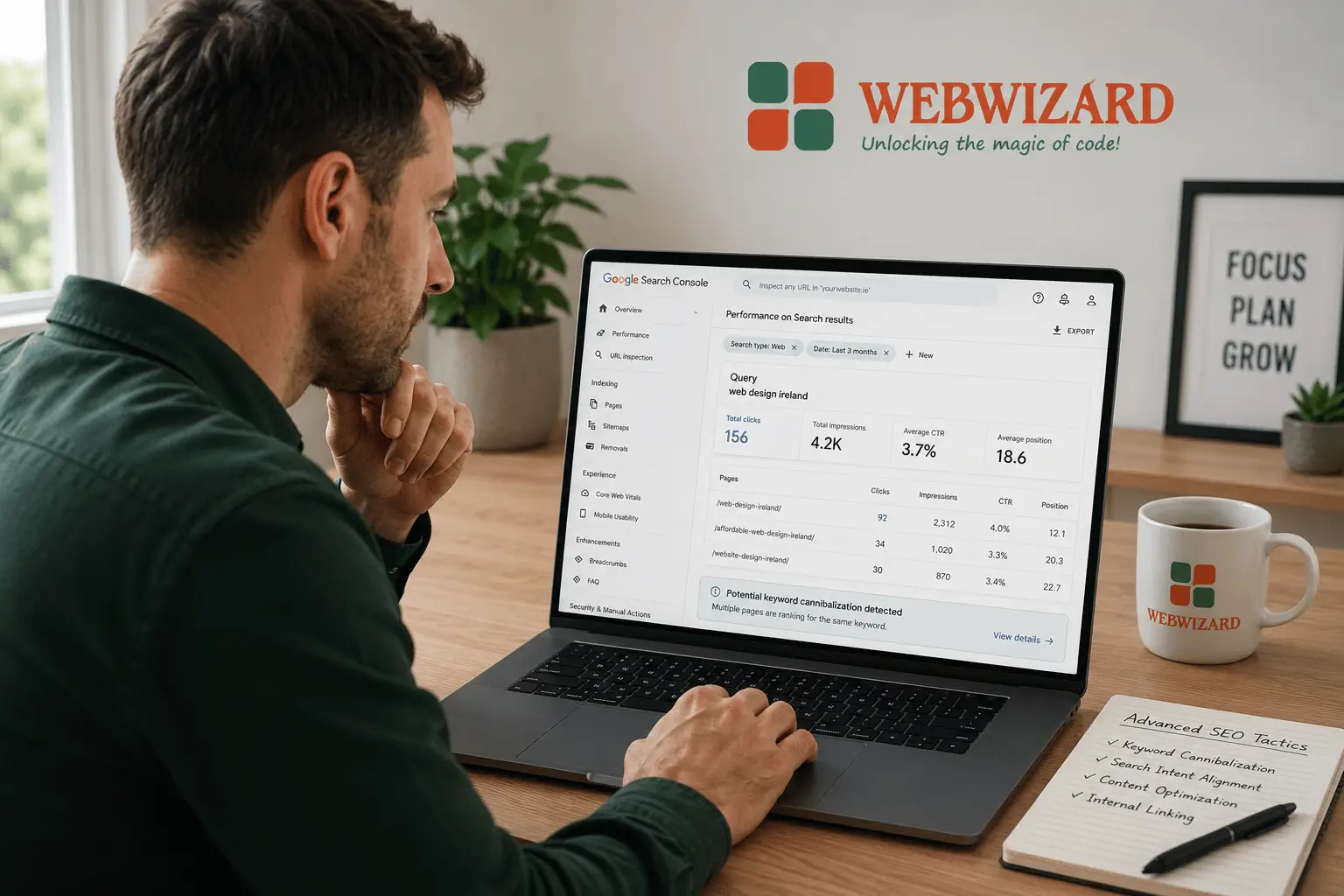
A free tool like Google Search Console will also show you, if your store is already live, which queries are bringing people to your product pages right now. You may find you are getting impressions for terms you never deliberately targeted - that is a signal to write more content around those themes.
For Irish ecommerce stores, adding location context to your keyword research often pays off. "Buy handmade candles Ireland", "men's wool jumper Ireland", "organic skincare products Dublin" - these terms have lower competition than their global equivalents and are more likely to convert because the buyer is specifically looking for an Irish supplier. If you ship from Ireland, that is a selling point worth building into your product copy.
The Anatomy of a Product Description That Ranks
A well-structured product description does not need to be long for the sake of it. But it does need to cover the right components in the right order.
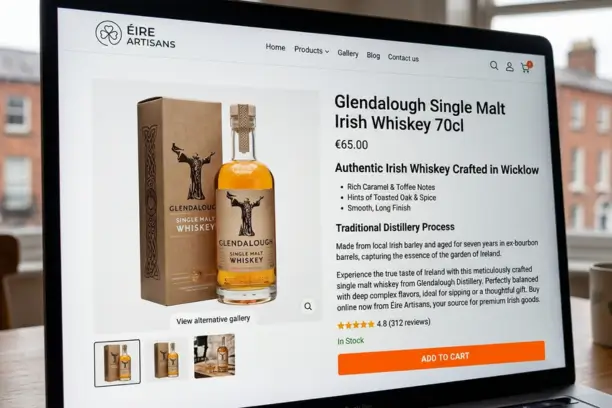
Open with a short, compelling lead sentence that includes your primary keyword naturally. This is the sentence Google is most likely to pull into a featured snippet, and it is the first thing a real buyer reads. Make it count. "This handmade soy wax candle is hand-poured in Galway using 100% natural fragrance oils" is far more effective than "A lovely candle you'll enjoy." The first is specific and credible. The second is meaningless.
From there, describe the product's benefits before its features. Features tell the buyer what the product is. Benefits tell them what it does for them. "300 thread count Egyptian cotton" is a feature. "Stays cool in summer and warm in winter, so you actually sleep through the night" is a benefit. Both have a place in your description, but lead with the benefit and follow with the feature that explains why.
Weave your secondary keywords into this section naturally. If your primary keyword is "linen duvet cover Ireland", your secondary terms might include "breathable bedding", "washable linen", "natural fabric duvet". These should appear because they are genuinely relevant to describing the product, not because you have forced them in.
Close the description with practical information: dimensions, materials, care instructions, delivery details. This is where features sit most comfortably. For Irish stores, include specifics like "delivered within 3-5 working days to ROI and Northern Ireland" or "VAT included in all prices." These details reduce buyer hesitation and reflect the real questions Irish shoppers have before committing.
Avoiding Duplicate Content: The Biggest SEO Risk for Irish Online Stores
Duplicate content is the single most damaging SEO issue affecting Irish ecommerce stores, and most owners do not know they have a problem. It happens when multiple pages on your site carry the same or very similar text - which is almost inevitable if you are selling products with variants (different sizes, colours, or materials) or if you have used manufacturer-provided descriptions.
When Google crawls your store and finds the same product description on ten different pages, it does not know which version to rank. It either picks one arbitrarily or discounts the content entirely. The result is that none of your product pages rank as well as they should, even if the descriptions are perfectly written.
The practical fix is to write a unique description for every product, even when products are similar. If you sell five versions of the same candle in different scents, give each one a distinct lead sentence, a different opening benefit, and slightly different supporting copy. This does not mean rewriting every word, but the first 100 words of each description should be different enough that Google treats each page as a unique piece of content.
For product variants like sizes and colours on Shopify or WooCommerce, use canonical tags to tell Google which page is the primary version. Your developer can set these up, or if you are using a well-configured Shopify theme, they are often handled automatically. If you are unsure whether duplicate content is hurting your rankings, the SEO audit services at Web Wizard include a duplicate content check as part of the review process.
Formatting for Readability: How Buyers and Google Both Process Your Copy
The way you format a product description matters as much as the words themselves. A wall of text, even if beautifully written, will put most buyers off - and Google interprets poor engagement signals (high bounce rate, short time on page) as a sign that the page is not delivering on its promise.
Short paragraphs work better than long ones. One to three sentences per paragraph is the right range for product copy. Use a single bullet list for quick-scan features or specifications - things like dimensions, weight, available sizes, or materials. Keep the list to five or six items maximum. If you find yourself writing eight bullets, some of those points belong in a paragraph instead.
Use your H2 and H3 heading tags within the product description if the page layout allows it. A heading like "Why This Jacket Is Different" or "Care and Washing Instructions" breaks up the page, helps Google understand the content structure, and gives buyers a clear way to jump to the section they care about most. Many Irish ecommerce stores skip this entirely and miss an easy ranking signal.
On mobile - which is where the majority of Irish shoppers browse - formatting matters even more. Long unbroken paragraphs are almost unreadable on a phone screen. Short, punchy sentences with clear visual breaks keep mobile visitors engaged long enough to make a decision.
Balancing SEO With Conversion Optimisation
SEO gets people to your product page. Conversion optimisation gets them to buy. These are not the same thing, and treating them as if they are leads to copy that serves neither goal well.
The most common mistake is writing product descriptions entirely for the search engine - hitting keyword targets, hitting word count targets - while completely ignoring the emotional and psychological triggers that actually cause people to make a purchase. A person buying a gift, treating themselves, or solving an urgent problem is not in a neutral information-gathering state. They have a feeling driving the decision, and your copy needs to acknowledge it.
This is where buyer persona research earns its value. Before writing copy for a product, think about who your typical buyer is. A 35-year-old woman buying skincare products in Cork is weighing different things than a 60-year-old man in Dublin buying a power tool. The former might respond to copy that emphasises skin type suitability and ethical sourcing. The latter wants to know load capacity, compatibility, and whether the brand is reputable. The same product, positioned differently, performs very differently.
Urgency and social proof are the two most underused conversion levers in Irish product copy. "Only 4 left in stock" is an honest, effective statement if it is true. "Over 200 orders shipped to Ireland this month" builds trust without feeling pushy. These lines do not belong in the main description - they sit better as supporting microcopy on the product page - but they are part of the full conversion environment your description lives in.
If you want to go deeper on this topic, the guide on conversion rate optimisation for Irish ecommerce stores covers page-level CRO tactics that complement strong product copy.
Product Description Length: How Much Is Enough?
There is no universally correct length for a product description. The right length depends on the product's complexity, the buyer's level of prior knowledge, and how competitive the keyword is. That said, the following table provides a practical starting framework for Irish ecommerce stores.
| Product Type | Recommended Description Length | Reasoning |
|---|---|---|
| Simple consumables (candles, soaps, food items) | 150-250 words | Buyer needs atmosphere and sensory cues, not technical detail |
| Clothing and accessories | 200-350 words | Fit, feel, sizing context, and styling suggestions all reduce returns |
| Home goods and furniture | 250-400 words | Dimensions, materials, care, and room suitability all need coverage |
| Electronics and tools | 300-500 words | Technical specs, compatibility, and use cases are all expected |
| Specialist or professional products | 400-600+ words | High consideration purchase - buyer needs confidence before committing |
One practical note: these are description lengths, not total page word counts. Your product page will also carry reviews, FAQs, related products, and navigation - all of which contribute to the overall content richness of the page. The description itself is just one piece of the SEO picture.
Fictional Case Example: Craft Supply Store in Wicklow
Fictional Case Example: Bridget runs StitchCraft Supply, an online haberdashery based in Bray, Co. Wicklow, selling fabric, thread, and sewing accessories. Her product descriptions were all lifted from her wholesale supplier's catalogue - identical to dozens of other Irish and UK stores. She was ranking on page four for most of her core search terms despite having good product photos and competitive prices.
After rewriting her top 30 products with original, benefit-led descriptions and incorporating long-tail keywords like "Irish linen fabric by the metre" and "quilting cotton fabric Ireland", she saw page-one rankings for nine of those products within four months. More importantly, her add-to-cart rate improved, because the new descriptions explained exactly what each fabric was suited for - quilting, dressmaking, home décor - meaning buyers had more confidence before purchasing.
Common Mistakes Irish Ecommerce Stores Make With Product Descriptions
Copying supplier descriptions verbatim. This is the most widespread mistake and causes immediate duplicate content problems. Your supplier's description is on their site, on every other retailer's site that stocks the same product, and possibly on the manufacturer's site too. Google has seen it all before. It will not rank duplicated content, and it certainly will not reward it.
Writing only for Google and ignoring the buyer. A description that reads "buy organic beeswax candles Ireland, natural candle Ireland, Irish made candle" is not a product description - it is a keyword list. No real buyer responds to that. It reduces trust, increases bounce rate, and ironically hurts your SEO because low engagement signals tell Google the page is not useful.
Leaving out practical information Irish buyers need. Shipping times, return policies, sizing guidance for clothing, compatibility notes for tech products - these are not optional extras. They are the questions buyers are silently asking while reading your description, and if they do not get answers, they leave. Irish shoppers in particular want to know whether a store ships from Ireland or abroad, because it affects delivery times, returns logistics, and customs fees for UK-based suppliers post-Brexit.
Ignoring title tags and meta descriptions for product pages. The product description on the page is important, but so is the meta title and meta description that appear in Google search results. Many Shopify and WooCommerce stores use auto-generated meta data pulled from the product name and first line of the description. This is rarely optimal. Write custom meta titles and descriptions for your most important products. Keep the meta title under 60 characters and include your primary keyword. Keep the meta description under 160 characters and make it sound like something a human wrote, not a keyword dump.
Treating all products equally. Not every product deserves a 400-word description, and not every product can survive on 80 words. High-margin products, bestsellers, and products you are actively trying to rank for deserve the most attention. Start there, not with everything at once.
How to Structure Your Writing Process
Writing good product descriptions at scale sounds daunting, especially if you have hundreds of products. The key is to build a repeatable process rather than treating each description as a blank-page challenge.
Start by grouping your products into categories with similar buyer profiles and similar keyword opportunities. Write a template for each category that defines the structure: opening benefit statement, key features, practical details, and call to action. Then vary the execution within that template for each individual product. This way you are not reinventing the approach every time, just filling in the specific details.
For your most competitive products - the ones you most need to rank for - do a proper keyword analysis before writing. Look at the top three Google results for your target search term. Note the headings they use, the questions they answer, the terms they repeat. Then write something that covers all of that and more. Do not copy their structure word for word, but use it as a benchmark for what thoroughness looks like in your category.
If your store is built on Shopify, the platform makes it straightforward to manage product descriptions at scale, and a well-structured Shopify build gives you clean URL structures and proper meta data fields for every product. If you are not confident the technical setup of your store is supporting your SEO efforts, the Shopify development service at Web Wizard covers both the build and the SEO groundwork that product descriptions sit on top of.
A broader look at what makes an ecommerce site perform well overall - beyond just descriptions - is worth reading if you are planning a new build or a refresh. The guide on designing an ecommerce website that actually converts covers the full picture.
Want Product Pages That Actually Rank in Ireland?
Talk to Web Wizard about an SEO audit or a new ecommerce build. No jargon, no hard sell - just practical advice for your store.
Start With Your Best-Selling Products and Build From There
Writing great product descriptions for an entire catalogue overnight is not realistic for most Irish small business owners. The smarter approach is to start with the products that matter most: your bestsellers, your highest-margin lines, and the products you most want to rank for. Get those right first, measure the impact over 60-90 days, then move through the rest of the catalogue with the same approach.
The payoff is real. Better product descriptions mean better rankings, which means more qualified traffic arriving on your pages. And when the copy is clear, specific, and written for the person reading it, more of that traffic converts. That is the whole point of the exercise.
If your store needs a technical foundation that supports all of this work, or if you are starting from scratch and want to get it right from day one, we would be glad to help. At Web Wizard, we build ecommerce stores and run SEO campaigns for Irish small businesses. Explore our Website Design Dublin services or get in touch for a no-obligation conversation about what your store needs.