Introduction
A domain name is the web address customers type or tap to reach your business online, such as webwizard.ie, and it is the single most permanent decision you will make when setting up a website. In Ireland, the choice is not just about picking a name you like: you need to decide between a .ie domain (which requires proof of a genuine connection to Ireland) and a .com or other extension, check who actually owns the registration once it is bought, and register it through a proper accredited registrar rather than a reseller with no accountability.
If you have ever tried to move a website away from a developer and discovered the domain was registered in their name, not yours, you already understand why this matters more than most business owners assume before it happens to them. This guide walks through what a domain name actually is, how .ie compares with .com and other extensions, how to pick a good one, how to check availability and register it properly, the mistakes that catch out Irish business owners most often, and what Google actually says about domain names and search rankings, as opposed to what SEO blogs claim it says.
What Is a Domain Name, and How Does It Fit With Hosting?
People mix these two things up constantly, so it is worth separating them clearly. A domain name is the address, like webwizard.ie. Hosting is the physical space where your website's files, images and database actually live, on a server somewhere. DNS, the Domain Name System, is the phone directory in between the two: it translates the address people type into the location of the server that holds your site, so a browser knows where to send the request.
Think of it like a shop. The domain name is the shop's address on the high street. Hosting is the building itself, the shelves and the stock room. DNS is the postal system that makes sure a letter addressed to that shop actually arrives at the right building rather than getting lost. You can buy your domain and your hosting from the same company, and plenty of Irish businesses do exactly that for convenience, but they are two separate products, often billed separately, and you do not have to buy them from the same place. Keeping that distinction clear matters later, because it affects who controls what if a relationship with a developer or hosting provider ever ends.
.ie vs .com vs Other Extensions: Which Should You Choose?
For a business trading primarily in Ireland, a .ie domain is usually the stronger choice, but it comes with an eligibility requirement that .com does not. According to .IE, the organisation that runs Ireland's national domain registry, every .ie registration requires proof of a genuine connection to Ireland. That connection can be established a few different ways: Irish citizens and residents can use a passport, driving licence, or a recent bank statement showing an Irish address; Irish-registered companies can use their CRO or RBN number, a VAT number, or a tax clearance certificate from Revenue; and businesses based outside Ireland can qualify by showing they actively trade with Irish customers, usually through sales invoices or a signed letter from an accountant or solicitor, alongside proof of their company's identity.
Why .ie Carries Extra Local Trust
That eligibility bar is exactly why .ie carries more local credibility than an open extension anyone can register with no verification at all. We covered this in detail in our post on why Irish consumers trust a proper website over social media alone, but the same registry research is relevant here: 84% of Irish consumers say they trust businesses with their own website, compared with 36% for businesses relying solely on social media, and part of that gap comes down to the visible signals a domain gives off. A .ie address tells an Irish visitor, correctly, that somebody had to prove a real connection to this country to register it. That is a small but genuine trust signal at the exact moment a customer is deciding whether to hand over a card number or book a consultation.
When .com or Another TLD Makes More Sense
None of this means .ie is automatically right for every business. If you sell internationally, plan to expand outside Ireland within the next year or two, or your brand name is already tied up with a .com you cannot get in .ie, then .com remains the safer long-term choice, since it is the extension most customers worldwide default to typing from memory. Startups building a product aimed at a global market, agencies with clients across the UK and EU, and SaaS businesses with no strictly Irish focus often do better sticking with .com and simply making the Irish connection clear through their content, address and phone number instead of the domain extension. There is also .irish, a newer option some heritage or culturally-focused brands use deliberately, though it has nowhere near .ie's recognition yet. If your budget stretches to it, buying both the .ie and the matching .com and pointing one at the other is common practice among Irish businesses that want to cover both bases.
Got Your Domain Sorted? Let's Build What Goes On It
Custom Web Design Starting at €1,500 | No Hidden Fees | Free Consultation | Custom, SEO-ready site in 4 weeks (not 12-16)
How to Choose a Good Domain Name for Your Business
Most of the domain names that end up costing a business money later were chosen in about ten minutes, under pressure, the night before a website launch. It is worth slowing down for this one. A good domain name is short, easy to say out loud, and easy to spell after hearing it once, because a huge share of your traffic will come from someone repeating your web address to a friend or typing it from memory after seeing it on a van or a shopfront sign. Hyphens and numbers cause more lost customers than most business owners expect: tell someone your address is "kearney-plumbing4.ie" over the phone and watch how often they type it wrong.
Where possible, match the domain to your actual brand or business name rather than a generic keyword string. "murphyselectrical.ie" beats "electriciandublin15.ie" for a business called Murphy's Electrical, even though the second one contains a popular search term, because the first one is what people will actually remember, search for by name, and trust once they have used you before. Before you commit, run a quick trademark check through the Irish Patents Office's public trademark search to make sure you are not about to build a brand on a name someone else already owns, since that is a considerably more expensive mistake to unpick after the fact than to check for up front. Finally, think a little further ahead than this year: if "corkcakes.ie" works today but you plan to expand nationwide next year, a name without the county baked into it will age better.
| Naming principle | Do this | Avoid this |
|---|---|---|
| Length | Short, ideally under 15-20 characters | Long strings that are hard to say aloud |
| Spelling | One obvious way to spell it | Clever misspellings or homophones |
| Structure | Brand name, no separators | Hyphens, numbers, underscores |
| Relevance | Matches your actual business or brand name | Generic keyword strings with no brand identity |
| Growth | Room to expand services or location later | Naming yourself into one town or one service forever |
| Legal risk | Checked against existing trademarks | Assumed to be fine because it was available |
How to Check Availability and Register a Domain Name Properly
Once you have a shortlist, checking availability is straightforward: use a WHOIS lookup tool, available free through most registrars and through the IE Domain Registry directly for .ie specifically, to see whether a domain is already registered and, where the data is public, who holds it. WHOIS records also matter after you register, because they are the official record of ownership; keeping them accurate is part of proving the domain is genuinely yours if a dispute ever comes up.
For registration itself, you must go through an accredited registrar. For .ie domains this is not optional: the IE Domain Registry only allows registrations through its list of accredited registrars, companies who have been formally approved to handle the identity verification and registration process on the registry's behalf. Well known Irish accredited registrars include Blacknight, Register365, LetsHost and Hosting Ireland, among others, and most also sell hosting and email packages alongside the domain if you want everything from one supplier. For .com and other generic extensions, any ICANN-accredited registrar will do the job, and the same Irish companies typically sell those too. If you plan to build on WordPress once the domain is live, our WordPress website design service covers how domain, hosting and platform choice fit together on one build.
On pricing, expect a first-year promotional rate followed by a higher renewal price, which is standard industry practice rather than anything to be suspicious of, provided the renewal price is disclosed clearly before you buy. At the time of writing, Irish registrars commonly advertise .ie domains from around €3 to €5 for the first year, renewing at somewhere between roughly €20 and €46 a year depending on the provider, while .com typically sits in a broadly similar renewal range. Always check the actual renewal price on the registrar's own pricing page before you commit, since first-year offers vary constantly and get outdated quickly in any article, including this one.
Does Your Domain Name Actually Affect SEO in 2026?
Having your target keyword inside your domain name does not give you a ranking boost, and it has not for years. Google's own SEO Starter Guide states plainly that "keywords in the name of the domain (or URL path) alone have hardly any effect" beyond appearing in breadcrumbs, and that the TLD you choose "only matters if you're targeting a specific country's users, and even then it's usually a low impact signal." Google's guidance is to pick a domain name that serves your business and your customers, not one stuffed with keywords in the hope of a shortcut that stopped working years ago.
That said, choosing .ie for an Irish-focused business is not really an SEO play, even though it does carry a mild country-targeting benefit for Irish search results. It matters more for trust, memorability and the local credibility signal covered earlier. What actually moves rankings is what you build on the domain: content quality, site structure, technical performance and backlinks, not the string of characters before the slash. Our guide on website structure for SEO in Ireland covers what genuinely influences rankings once the domain is sorted, and our SEO services page explains how we approach that work for Irish clients. Understanding what E-E-A-T is and why Google uses it to rank your website will explain why the content sitting on your domain matters far more than the domain string itself, and our advanced SEO tactics for Irish businesses guide covers what to focus on next. If you are weighing up whether AI tools have changed any of this, our piece on AI content and SEO for Irish businesses is worth a read too, since the same principle applies: substance beats shortcuts.
Fictional Case Example: Kearney Joinery's Domain Mix-Up
Kearney Joinery, a small bespoke furniture workshop outside Ennis, hired a local freelancer three years ago to build their first website and register their domain. The freelancer bought "kearneyexample.ie" using their own personal account, as many do to save the client a step, and never mentioned it. When Kearney Joinery wanted to switch to a new web designer this year for a redesign, they discovered they had no login for the domain itself, only the website's admin panel. Getting the domain transferred took six weeks of emails, because the freelancer had since changed phone numbers and was slow to respond, and the business could not point their email or update their site elsewhere in the meantime. They now hold the domain under their own company details with auto-renew and two-factor authentication switched on, and it is the first thing they check with any new supplier before signing anything.
Common Mistakes Irish Businesses Make When Buying a Domain Name
Letting an agency or developer register the domain in their own name. This is the single most damaging mistake on this list, and it happens constantly, usually with no bad intent, just convenience. If the relationship ever sours or the agency closes, you can lose control of your own web address. Always insist the domain is registered under your business's own account and details from day one. Our guide on how to choose a web designer in Ireland covers exactly what questions to ask before signing anything, and it is worth reading before you hire anyone.
Letting the registration lapse. Domains expire on a fixed renewal date, and if a card fails or an old email address stops being checked, you can lose a domain you have used for years, sometimes to someone else entirely. Set auto-renew on, keep payment details current, and make sure whoever manages your website maintenance also has renewal dates on their radar, because a lapsed domain can take a working website offline overnight with no warning.
Buying from unaccredited resellers. Some third-party sellers offer domains, particularly .ie ones, without being properly accredited to handle them, which can leave you with unclear ownership records or no proper support if something goes wrong. Stick to a recognised, accredited registrar, even if a marketplace listing looks slightly cheaper.
Ignoring WHOIS or domain privacy settings. Depending on the registrar and extension, your name, address and contact details can be publicly visible in WHOIS records unless you enable privacy protection, which most registrars offer for free or a small fee. Skipping this is a minor but avoidable exposure, particularly for sole traders registering under a home address.
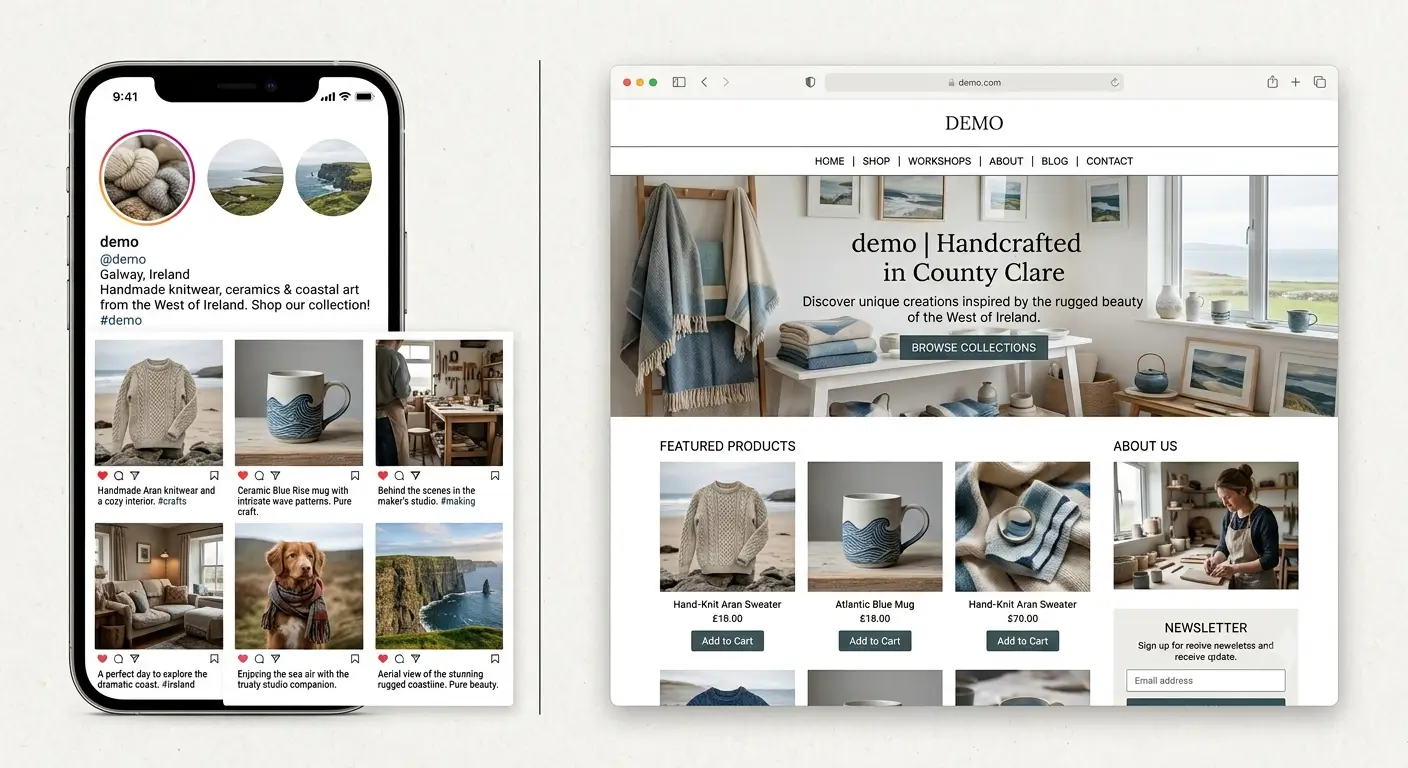
Forgetting to secure matching social handles. Once you land on a domain name, check Instagram, Facebook and LinkedIn for the same handle straight away. A mismatch between your website address and your social profiles undermines the brand consistency you just spent time getting right, and a common handle gets harder to secure the longer you wait.
Already Have a Domain? Make Sure It's Actually Yours
We check domain and hosting ownership as standard on every new project, before we build a single page. Free Consultation | Custom, SEO-ready site in 4 weeks
Buying a Domain as Part of a Wider Website Project
If you are choosing a domain name because you are building your first website, or planning a rebrand, it is worth thinking about the domain and the site together rather than in isolation. A domain decision made in isolation from your wider brand and content plan often needs revisiting within a year. If you are redesigning an existing site under a new name, our post on website redesign strategy and planning covers how to handle the transition without losing the SEO value your old domain built up, and our website redesign service handles that migration properly, which matters if you are moving from one domain to another rather than starting fresh. If you are gathering quotes from more than one developer for the build itself, our guide on how to evaluate a web design quote in Ireland explains what to check before you sign, including who ends up holding the domain.
For ecommerce specifically, our guide on building customer trust on a new ecommerce store touches on why a clean, owned domain matters even more when you are asking customers to enter payment details, and our ecommerce website design service covers the full build from domain through to checkout. If you are setting up on WooCommerce specifically, our WooCommerce setup checklist is a useful next step once the domain is registered. Once the site is live, keeping content fresh matters too: our piece on how often you should update your website content is a natural next read, and getting the homepage right from launch makes sure the domain you fought for actually converts once people arrive.
Frequently Asked Questions
Getting Your Domain Name Right From the Start
A domain name is a small purchase with a long tail: get it right and it quietly supports your brand for a decade or more, get it wrong and you end up either stuck with a name that does not fit or, worse, fighting to get control of an address you thought was already yours. Take the time to choose something short, ownable and true to your brand, confirm your eligibility if you are going for .ie, register through a proper accredited registrar under your own business details, and treat the domain as one part of a wider website decision rather than an afterthought.
If you are planning a new website and want a hand getting the domain, hosting and build sorted properly from day one, with everything registered in your name, not ours, get in touch with Web Wizard for a no-obligation conversation about your project.