Introduction
Somebody has just emailed you a web design quote. It might be one page with a single number on it, or it might be four pages of jargon you skimmed rather than read. Either way, you are now expected to decide whether it is fair, whether it is missing something important, and whether the person who sent it is someone you actually want holding your business's website for the next few years. That decision is harder than it should be, because almost every web design quote in Ireland looks reasonably professional on the surface. The difference between a good one and a bad one is rarely visible in the formatting. It is in what the quote does and does not say.
This guide is not about choosing a designer from scratch. It assumes you already have a quote, or several, sitting in your inbox right now. It walks through exactly what a trustworthy web design quote should itemise, the specific wording that should make you stop and ask questions, the pricing models you will encounter and what is reasonable for each, and the questions worth asking before you sign anything. If you have not yet shortlisted anyone and want the broader picture on choosing a designer in the first place, our guide on how to choose a web designer in Ireland covers that earlier stage. This one starts where that one leaves off: quote in hand, pen hovering over the signature line.
What a Trustworthy Web Design Quote Should Itemise
A web design quote worth signing reads less like a sales pitch and more like a specification document. It should answer, in writing, exactly what you are getting, exactly what you are not getting, and exactly what happens if either of those things changes mid-project. A one-line total with no breakdown is not a quote. It is a guess dressed up as a number.
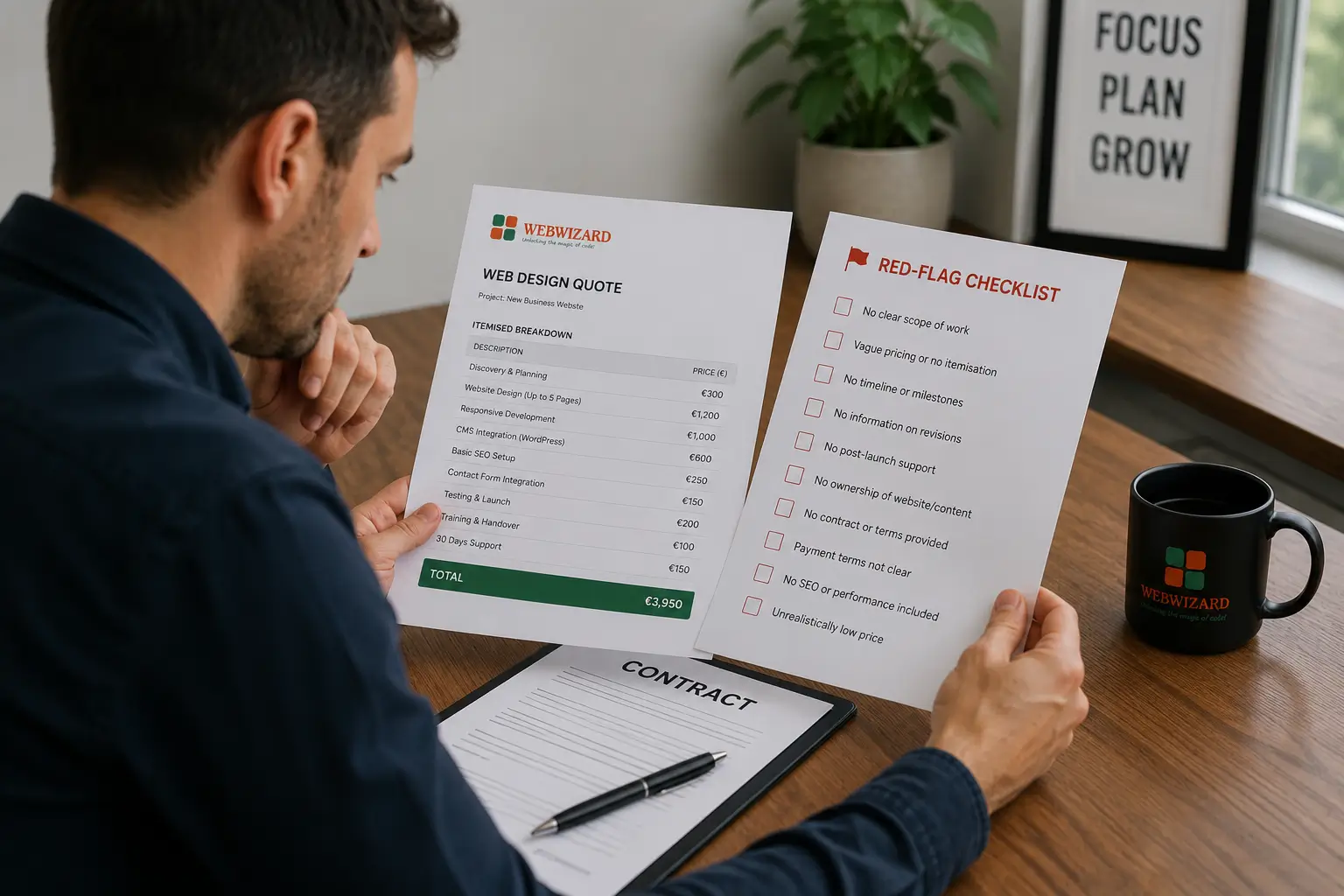
In short: a proper web design quote itemises the number of pages included, the number of revision rounds, who pays for and manages hosting, what ongoing maintenance costs after launch, who owns the domain and source code, a timeline broken into milestones, which basic SEO tasks are included, and a clear list of what is explicitly excluded from the price. If any one of those eight items is missing, ask for it in writing before you go any further.
Pages and Scope
The quote should state a specific page count, not "a full website." Five pages means five pages: home, about, services, contact, and one more, typically. If your business needs a blog, a booking form, staff bios, or a resources section, each of those should be named individually, because "full website" means something different to every agency that uses the phrase.
Revisions
Look for a stated number, such as two rounds of design revisions and one round of copy revisions. "Unlimited revisions" sounds generous but usually means the opposite in practice: without a defined process, minor tweaks drag on for months and the project never quite finishes, because there is no point at which either side agrees the work is done.
Hosting and Ongoing Maintenance
Hosting is rarely free forever, and it should not be presented as if it is. A trustworthy quote states who hosts the site, what that costs per year, and what happens if you want to move hosting providers later. Separately, it should state what ongoing website maintenance costs once the build is finished, whether that is a monthly retainer, a per-hour rate for updates, or nothing at all beyond the initial build. Plugin updates, security patches, and small content changes all cost something, either in money or in your own time, and a good quote tells you which one it will be.
Ownership of Source Code, Assets and Domain
This is the single most important line item in the whole document, and it is the one most often left vague on purpose. The quote should state plainly that you, the client, own the domain name outright, own the full source code and can export it at any time, and own the images, copy, and brand assets created during the project. If the quote is silent on ownership, assume the worst and ask directly. We cover why this matters so much in practice further down, because it is the clause that causes the most damage when it goes wrong.
Timeline and Milestones
A specific number of weeks with named milestones, discovery, design approval, development, testing, launch, tells you the agency has actually planned the project rather than picked a number that sounds achievable. "A few months" is not a timeline. It is a placeholder for one.
SEO Basics Included
Basic on-page SEO, proper heading structure, meta titles and descriptions, image alt text, and a submitted sitemap, should be included in any professional build, not sold separately as an upsell after the fact. A quote that treats fundamental SEO as an optional extra is usually a sign that search visibility was not considered during the actual build, which means retrofitting it later costs more than building it in from day one.
What Is Explicitly Excluded
The best quotes are as clear about what is not included as what is. Stock photography licences, copywriting for more than the agreed page count, ecommerce payment gateway setup, ongoing social media management, these should all be named as exclusions if they are not part of the price. A quote with no exclusions section at all has usually just not thought that far ahead, which is not reassuring when your money is on the table.
Fixed Price, Hourly, or Retainer: Which Pricing Model Fits Your Project
Web design quotes in Ireland tend to follow one of three pricing structures, and each one suits a different type of project. Knowing which model you are being offered, and whether it is the right one for what you actually need, matters more than the headline figure.
Fixed price is the most common model for a defined brochure or small business website, and it is usually the right choice when the scope, pages, features, and content, is clear before work starts. You know the total cost upfront, and the agency carries the risk if the project runs long. The trade-off is that anything added mid-project, an extra page, a new feature, gets billed separately, so the fixed price is only as reliable as the scope document behind it.
Hourly billing makes sense for smaller, undefined pieces of work: fixing a bug, making a batch of content updates, or a project where requirements are genuinely likely to shift as you go. It is a poor fit for a full website build, because an hourly rate with no cap gives you no way to budget accurately, and a slow developer costs you more for the exact same result as a fast one.
Retainer or monthly pricing suits ongoing work rather than a one-off build: continuous SEO, regular content updates, or a maintenance and support arrangement where the scope of work varies month to month. A retainer for the initial build itself, rather than for ongoing support after launch, is where you need to look closely at what happens if you want to leave. Some agencies structure the build itself as a subscription specifically so that the site stops working, or becomes inaccessible, the moment you stop paying. That is a different arrangement from a genuine maintenance retainer, and the two get blurred together in marketing more often than they should.
| Pricing Model | Best Suited To | What to Watch For |
|---|---|---|
| Fixed price | A defined brochure or small business site, five to ten pages | Scope creep on anything added after signing; get the page count and feature list in writing |
| Hourly | Small fixes, content updates, undefined or evolving work | No cap on hours means no real budget; ask for an estimated range and a check-in point |
| Retainer / monthly | Ongoing maintenance, SEO, or support after launch | Confirm whether the site still functions if you cancel, and whether you keep the code either way |
For most Irish small businesses commissioning a standard business website, fixed price for the build with an optional monthly retainer for maintenance afterwards is the combination that gives you the clearest picture of total cost, both upfront and ongoing.
Not Sure If Your Quote Stacks Up? Get a Second Opinion
Custom Web Design Starting at €1,500 | No Hidden Fees | Free Consultation | Custom, SEO-ready site in 4 weeks (not 12-16)
Red Flags That Should Make You Reject a Web Design Quote
Some of these are subtle enough that you would not notice unless you were looking for them specifically. Others are obvious once someone points them out. Either way, any one of the following is a legitimate reason to walk away, not just a detail to raise afterwards.
Vague or undefined scope. "Full custom website" with no page count, no feature list, and no content plan is not a scope, it is a placeholder. Vague scope is how a €1,500 job quietly turns into a €4,000 job by week six, with both sides blaming the other for the difference.
No ownership of source files or the domain name. If the quote does not confirm, in writing, that you own the domain and source code once the final invoice is paid, treat that as disqualifying on its own. Some agencies register domains under their own account or build on a platform you cannot export from, which means your website can effectively disappear if you ever fall out with them or they stop trading.
Hidden recurring fees. A build that looks like a one-off cost but is actually a monthly subscription in disguise, a "licence fee" to keep your own site live, an undisclosed hosting mark-up, needs to be spelled out before you sign, not discovered on your first invoice after launch.
Unrealistic timelines or prices that seem too good to be true. A custom five-page business website quoted at €400 with a one-week turnaround usually means a heavily templated build with no real customisation, no SEO setup, and no discovery process behind it. Genuinely custom work takes real hours, and real hours cost real money. If a price looks impossible, it usually is.
No written contract. A verbal agreement over a phone call, or a quote with no accompanying terms document, leaves you with no recourse if the finished product does not match what was discussed. Get the scope, price, timeline, and ownership terms in one signed document before any deposit changes hands.
Lock-in to a proprietary platform you cannot leave. Some closed, proprietary website builders make it difficult or impossible to export your site and move to another provider. A WordPress build avoids this specific problem because the platform is open source and portable to any hosting provider, but plenty of proprietary alternatives exist that quietly tie you to one company indefinitely. Ask directly what happens if you want to leave in two years, and listen closely to how confidently that question gets answered.
Unclear payment terms or an oversized deposit. A standard structure ties payment to approved milestones, commonly a deposit at signing, a payment at design approval, and a final payment at launch. A demand for the full amount upfront, before any work has started, shifts all of the risk onto you with none of the protection a staged schedule gives.
Fictional Case Example: Coastline Physio's Signature-Line Mistake
Coastline Physio, a two-practitioner clinic in Sligo, accepted a quote for €1,100 that promised a "complete custom website in one week." There was no written scope document, no mention of who would own the domain, and the deposit requested was the full amount upfront. Three weeks after the site launched, the practice wanted to add a second practitioner's bio and discovered the CMS login had never been shared with them. The domain, it turned out, had been registered under the designer's personal account. When the designer became unresponsive, Coastline had to involve a solicitor simply to recover their own domain name, then paid a second agency €2,600 to rebuild the site properly with clear ownership terms. The original €1,100 "saving" ended up costing more than three times over.
Questions to Ask Before You Sign
A short, direct list of questions on your first proper call will expose most problems faster than reading the quote alone. Ask them plainly and pay attention to how quickly and specifically they get answered.
- How many pages, and which specific pages, are included in this price?
- How many rounds of design and content revisions are included before extra work is billed separately?
- Who owns the domain name, source code, and content once the final invoice is paid?
- What does hosting cost per year, and can I move to a different hosting provider whenever I choose?
- What happens if I want to cancel a maintenance retainer, does the site keep working?
- What is the payment schedule, and is it tied to approved milestones or fixed calendar dates?
- What basic SEO work is included in the build itself, rather than sold as a separate add-on later?
- What is explicitly excluded from this price?
A designer or agency that answers all eight without hesitation, and puts the answers in writing, has almost certainly given you a fair quote. Hesitation, vagueness, or a request to "trust the process" on any of these is worth taking seriously. It is also worth checking how the agency talks about search visibility during this conversation. Our explainer on what E-E-A-T is and why Google uses it to rank websites is a useful reference here, an agency that cannot explain in plain terms why your site would rank has probably not thought about it either.
Want a Quote With No Fine Print to Decode?
Custom Web Design Starting at €1,500 | No Hidden Fees | Free Consultation | SEO-Ready and Live in 4 Weeks
Common Mistakes Business Owners Make When Reviewing a Quote
Comparing only the bottom-line number. Two quotes that both say "€2,000" can mean completely different projects once you look at what each one actually includes. One might cover SEO setup and three revision rounds, the other might cover neither. Compare line by line, not headline figure to headline figure. If either quote includes service pages as part of the build, check what those pages actually contain, our guide on how to build a service page that converts shows what a properly scoped page should include, which is a useful yardstick against a vague line item that just says "service pages included."
Not asking about ownership until after signing. By the time domain or code ownership becomes a live problem, you have usually already paid and the site is already public. Ask before you sign, every time, no exceptions.
Assuming a longer contract means better value. A twelve-month retainer locked in before you have seen a single deliverable is a commitment, not a bargain. Start with the build itself, and add ongoing retainer work once you have a track record with that agency to judge by.
Not checking whether the finished site will actually be usable. A quote can tick every box on ownership and pricing and still describe a site that is confusing for visitors to use. Our piece on what makes a website design user-friendly is worth reading alongside any quote, since it covers the practical usability standards a build should meet regardless of price.
Treating a low price as a discount rather than a warning. A quote significantly below every other one you received usually means something has been left out, not that you found a better deal. Ask directly what is different about their price before assuming you got lucky.
Skipping the written contract because the quote already covers it. A quote and a contract are not the same document. The quote states a price. The contract states obligations, timelines, ownership, and what happens if either side wants to exit. You need both, and you need them before any deposit is paid.
Reading the Quote Against Your Own Project
Once you understand what should be in a quote and what should worry you, the last step is holding the document up against your specific project rather than a generic checklist. An ecommerce build has different exclusions worth checking, payment gateway fees, product upload counts, inventory sync, than a five-page service business site. If your project involves a Shopify or ecommerce build, make sure the quote states clearly who uploads your product catalogue and how many SKUs are included before extra charges apply.
If part of your project involves letting customers book appointments or consultations directly, check whether that functionality is priced into the quote at all. Our guide on adding an online booking system to your website explains what that feature typically involves, so you can judge whether "booking system included" in a quote means a proper calendar integration or just a contact form with a different label on it.
If you are weighing a full new build against refreshing an existing site, the quote should also make clear which one you are actually being sold. Our guide on website redesign strategy and planning is worth reading alongside any quote for redesign work specifically, since a rebuild and a targeted website redesign are priced very differently and a vague quote can blur the line between the two on purpose. And if part of what you need is a custom booking system, client portal, or other functionality beyond a standard brochure site, check whether the quote is pricing a template plugin or genuine custom development, because the two look identical on a one-line invoice and cost very differently to build properly.
How the Underlying Website Structure Affects What a Fair Quote Looks Like
A quote is easier to judge once you understand roughly what should be involved in building the site properly. If your project includes several service pages, a blog, or category structure, the quote should reflect real planning around website structure for SEO, not just a page count with no thought given to how those pages link to each other. Similarly, if the quote mentions WordPress as the platform, ask whether ongoing plugin updates are included in the price or billed separately, since failing to keep plugins updated is one of the most common ways an otherwise well-built WordPress site becomes a security liability within a year of launch.
It is also worth checking whether the quote includes any plan for keeping the site current after launch. A site that is delivered and never touched again loses relevance quickly. Our piece on how often you should update your website content covers what tends to go stale first, and whether that ongoing work is priced into your quote or left entirely to you is exactly the kind of detail worth clarifying before you sign, not six months after launch.
Making the Final Call on Your Quote
By the time you have checked itemisation, pricing model, ownership terms, and the questions in this guide, you should have a clear answer rather than a gut feeling. A good quote survives scrutiny. It gets more reassuring the more questions you ask, not less. A bad one gets vaguer the closer you look, and that vagueness is the real red flag, more than any single clause on its own.
None of this requires legal training. It requires slowing down before you sign, reading the document properly instead of skimming to the total, and asking the eight questions above out loud on a call rather than assuming the answers. Most business owners skip this step because they are busy, and most of the expensive quote-related disputes in Ireland's small business market trace back to exactly that.
If you would like a straight, itemised quote with clear ownership terms before you commit to anything, get in touch with Web Wizard for a no-obligation conversation about your project. We are happy to walk through exactly what would be included, in writing, before you decide anything.