Introduction
Most Irish business owners think about their website one page at a time. They agonise over the homepage headline, rewrite the "About" page three times, and build service pages that look fine in isolation. What they rarely stop to consider is how all those pages work together as a system - and that gap is exactly where most small business websites lose ground to competitors in search results.
Website structure for SEO is not a technical topic reserved for developers. It is a planning decision, and it shapes everything that follows: which pages rank, which keywords you actually target, how Google reads and understands your site, and whether a visitor who lands on your electrical services page can find your emergency callout page in one click. This guide walks through how to plan your site structure deliberately, so your homepage and service pages work as a coordinated whole rather than a collection of unrelated documents.
What Website Structure for SEO Actually Means
Website structure for SEO refers to how the pages of your website are organised, how they relate to each other through links and URL paths, and how clearly that organisation signals meaning to Google. A well-structured website tells search engines exactly what each page is about, which pages matter most, and how they connect to each other. An unstructured website presents Google with a flat pile of pages it has to interpret on its own - and in that situation it usually defaults to ranking your competitors instead.
For a small Irish service business, the practical concern is straightforward: does Google understand that your homepage represents your brand as a whole, your service pages represent specific things you offer, and your location pages represent specific areas you serve? If yes, Google can rank each page for the right search queries. If no, your pages compete against each other for the same searches, and none of them rank as well as they should. This problem is called keyword cannibalization, and it is one of the most common structural issues on Irish business websites.
The structure of your site also affects how easily visitors can navigate it. A visitor who arrives via Google searching for "emergency electrician Dublin" should be able to reach your Dublin page, your contact form, and your emergency callout pricing within two or three clicks. Good structure makes that possible. Poor structure makes it a frustrating maze that ends with a closed tab and an enquiry going to a competitor.
How Your Homepage and Service Pages Have Different Jobs
The single biggest misunderstanding I see in Irish small business websites is treating the homepage as a detailed sales page and the service pages as secondary supporting content. It is actually the other way round. Your service pages are where conversions happen. Your homepage is where authority and brand credibility land - and that authority, used correctly, flows outward to strengthen everything else.
Understanding this distinction is the foundation of a well-structured site. Your homepage and service pages are not competing for the same job. They each have a specific role in how your site performs in search and how visitors move through it. The guide on what makes a high-converting business website in Ireland covers this idea in the context of individual page performance - but the structural dimension runs deeper than any single page.
The Homepage: Authority Hub, Not a Landing Page
Your homepage is the most authoritative page on your domain. It attracts the most inbound links, receives the most direct visits, and Google gives it the highest crawl priority by default. That authority is a resource. Used well, it flows outward through internal links to your service pages, giving them a stronger foundation from which to rank. Used badly - by overloading the homepage with keyword repetition or treating it like a giant product listing - it starts to compete with your service pages for the same search terms and dilutes the effectiveness of both.
The homepage should target your broadest brand keyword. For a web design agency in Dublin, that might be "web design agency Dublin" or "professional website design Ireland". For a family solicitor in Cork, it might be "solicitor Cork". The homepage confirms what you do at a business level. It introduces the services and links to the pages that explain them in depth. It does not need to cover every detail of every service - that job belongs to the service pages themselves.
Service Pages: Where the Actual Conversions Happen
A visitor who lands on your service page from a specific Google search already has intent. They are not browsing - they are evaluating options. Your service page needs to confirm you offer exactly what they are looking for, explain what the service involves, demonstrate credibility, and make it easy to get in touch. That specific, conversion-focused job is different from the homepage's role, and the content has to reflect that difference.
Each service page should own one keyword - or a closely related cluster - that sits one level below the homepage's primary term in specificity. If the homepage targets "solicitor Cork", your service pages might target "conveyancing solicitor Cork", "family law solicitor Cork", and "employment law advice Cork". Each page has a distinct keyword focus. None of them compete with the homepage, and none of them compete with each other. For a detailed breakdown of what each individual service page needs to include to turn visitors into enquiries, the Web Wizard post on building a service page that generates enquiries covers every element including copy structure, trust signals, and CTA placement.
How to Allocate Keywords Across Your Pages Without Cannibalising Yourself
Keyword cannibalization happens when two or more pages on your site target the same search term, causing them to compete against each other in Google's results. Google cannot decide which one to rank, so it alternates between them unpredictably or ignores both in favour of a more clearly focused competitor. It is one of the most common and most fixable problems on Irish business websites, and it almost always happens because nobody made a deliberate decision about which page should own which keyword before building the site.
The principle to apply is simple: every page on your website should be the definitive answer on your site for one specific query. Other pages can reference that topic, but they should link to the definitive page rather than cover the same ground at the same depth. In practice, this means creating a keyword map before you build or restructure your site. List every page, write the primary keyword next to it, and check for overlaps. If two pages share the same keyword, one of them needs to be narrowed, merged, or redirected.
A common version of this problem in Ireland involves trades businesses. A plumbing company might have a homepage targeting "plumber Dublin", a general services page also mentioning "plumber Dublin" in its headline, and an emergency plumbing page that somehow uses the same phrase again. All three pages are competing for the same query. The solution is not to remove all mentions of "plumber Dublin" - it is to ensure only one page treats it as its primary focus, and that page goes deeper on the topic than any of the others. Depth is the differentiator Google uses when two pages appear similar.
When you are ready to review how your current navigation structure affects the visibility of these pages, the post on website navigation design for more conversions offers a practical companion framework for how your menu labels and navigation hierarchy work together with your page structure to guide both visitors and search engines.
Not Sure How Your Pages Are Structured for SEO?
Custom Web Design Starting at €1,500 | No Hidden Fees | Free Consultation | Custom, SEO-ready site in 4 weeks (not 12-16)
URL Structure: How Your Folder Paths Signal Hierarchy to Google
Your URL structure is the visible map of your site hierarchy. It tells Google the relationship between pages before it has read a word of your content. A URL like /services/boiler-installation-dublin/ communicates that boiler installation is a service offered by this business, and that it is located in Dublin. A URL like /page-2-services-B/ communicates nothing at all.
For most Irish small business websites, a clean, relatively flat URL structure is best. You do not need multi-level subfolder hierarchies on a ten-to-twenty-page site - those add crawl complexity without meaningful benefit at that scale. What you do need is short, descriptive slugs that include each page's primary keyword (e.g. /conveyancing-solicitor-cork/, not /our-legal-services-page1/), consistent use of hyphens rather than underscores, and clean, readable URLs with no session parameters or tracking codes baked in permanently.
Location pages are the one case where a simple subfolder structure earns its place. If you serve multiple towns or counties, a structure like /web-design-westmeath/mullingar/ cleanly communicates the geographic hierarchy and makes it easier for Google to understand the relationship between a county-level page and a town-level page beneath it. You can see how Web Wizard handles this with the Web Design Westmeath landing page, which sits as a parent above more specific location sub-pages.
One important caution: if your site is already indexed by Google and your current URLs have accumulated rankings or backlinks, change them only with proper 301 redirects in place for every URL that moves. A page that ranked on page one of Google for a competitive keyword and then gets a new URL without a redirect loses all of that accumulated authority instantly. The full detail of how to handle this safely during a redesign is in the Web Wizard guide on how to redesign your website without losing SEO rankings.
Internal Linking: The Architecture Behind the Architecture
If URL structure is the skeleton of your site, internal linking is the connective tissue. It is how authority flows from your high-traffic, high-authority pages - typically the homepage - to the pages you most want to rank. It is also how Google discovers pages it has not yet crawled and how visitors find their way from one relevant piece of content to the next.
Your homepage should link directly to every core service page. This does two things. First, it ensures those pages are reachable from your most important page in a single click - the closer to the root of the site, the more crawl attention and authority those pages receive. Second, it explicitly tells Google which pages matter most to the business, through both the presence of the links and the anchor text used.
Anchor text is where many sites go wrong. "Click here for more" tells Google nothing about the destination page. "Boiler installation service Dublin" tells Google exactly what the linked page covers and reinforces its primary keyword. Use descriptive, contextual anchor text on every internal link. It does not need to be forced - it just needs to be specific rather than generic. The conversion rate optimisation guide on the Web Wizard blog explores how the placement and phrasing of these links on pages also affects how visitors navigate and convert, beyond the purely technical SEO dimension.
Your service pages also need inbound internal links from multiple places - not just the homepage. Blog posts are the most natural source. A post titled "How Long Does Boiler Installation Take?" is a natural gateway to your boiler installation service page. If that blog post does not link to the service page, you are losing a conversion opportunity every time someone reads it. Aim for each core service page to receive internal links from at least three or four different pages on your site: the homepage, one or two closely related service pages, and two or three blog posts on related topics.
The Hub-and-Spoke Model for Irish Service Business Websites
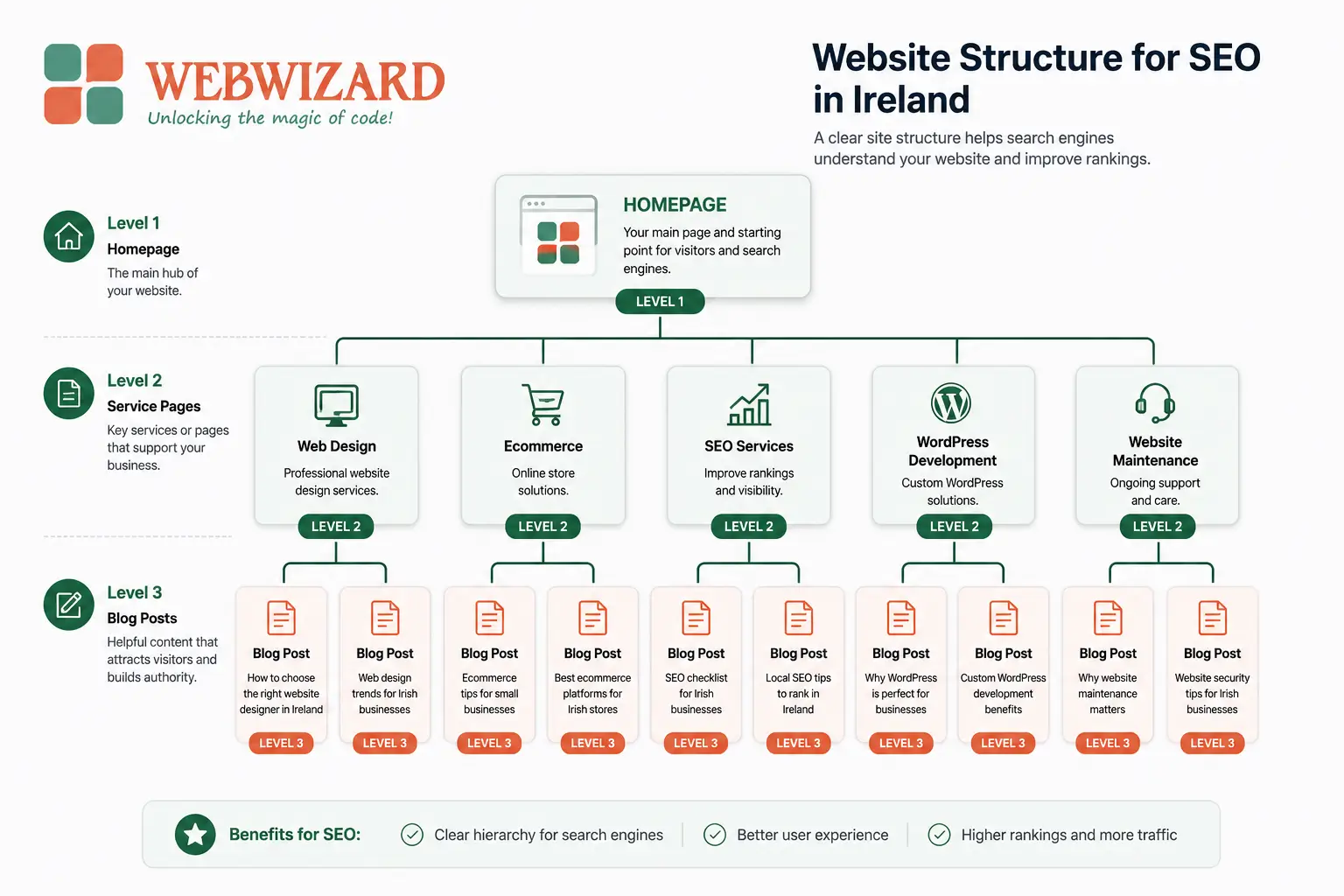
The most practical structural framework for an Irish SME service website is the hub-and-spoke model. The homepage is the hub. Each core service page is a spoke extending from it. Each spoke may have its own secondary spokes - location sub-pages, case studies, or supporting blog content - branching further outward. The hub links to all the spokes. The spokes link back to the hub. Blog posts link to the relevant spokes they support.
This structure prevents the "flat pile of pages" problem, where every page links to every other page without any hierarchy and nothing feels more important than anything else. In a flat pile, Google has no clear signal about which pages to prioritise for ranking. In a hub-and-spoke structure, the hierarchy is evident: the homepage holds the most authority, the core service pages hold the second tier, and supporting content exists to direct traffic toward those service pages rather than to compete with them.
Below is how this structure translates into practice for a typical Irish service business:
| Level | Page Type | Example URL | Primary Keyword Target | Links To |
|---|---|---|---|---|
| Hub | Homepage | / | electrician Dublin | All core service pages |
| Spoke | Service Page | /electrical-installation-dublin/ | electrical installation Dublin | Homepage, related service pages, blog posts |
| Spoke | Service Page | /emergency-electrician-dublin/ | emergency electrician Dublin | Homepage, related service pages, blog posts |
| Sub-spoke | Location Page | /electrician-south-dublin/ | electrician south Dublin | Parent service page, homepage |
| Support | Blog Post | /blog/how-to-choose-an-electrician-dublin/ | how to choose an electrician Dublin | Relevant service page, homepage |
Each element knows its role. Nothing is adrift. And crucially, any given page that ranks in Google leads a visitor back toward a service page where they can take action rather than to a dead end.
Fictional Case Example: Flanagan Electrical, a two-person contracting business based in Portlaoise, had a website with eight pages all sitting at equal depth in the navigation. They had separate pages for commercial work, domestic work, rewires, and emergency callouts - but none were linked to each other in the body content, none were mentioned in the homepage text below the fold, and the blog sat entirely disconnected from the service pages with no outbound internal links at all. After restructuring the site using a hub-and-spoke approach - rewriting the homepage body to summarise and link to each service page, adding contextual links from blog posts to the relevant service pages, and ensuring each service page linked to at least two related pieces of content - organic traffic to the service pages increased consistently over the three months that followed, with no content rewriting or external link building involved. The pages were the same. Their relationship to the rest of the site was different.
Want a Website Built With the Right Structure From Day One?
Custom Web Design Starting at €1,500 | No Hidden Fees | Free Consultation | Custom, SEO-ready site in 4 weeks (not 12-16)
Common Mistakes That Break a Business Website's Structure
Most Irish business websites with structural problems were not built badly on purpose. They grew organically over time - a page added here, a blog post there, a new service tucked into the navigation without much thought. These are the structural problems that come up most often and cost the most in lost rankings.
Treating All Pages as Equally Important
When every page sits in the main navigation at equal visual weight, linked from the homepage equally, Google sees a flat site with no discernible hierarchy. It cannot tell which service matters most to the business or which pages deserve ranking priority. The fix is to link to your most important service pages more often: in the homepage body text, from multiple blog posts, and from related service pages. Frequency of internal linking is how you signal priority without changing any on-page content.
Using the Same Keyword Across Multiple Pages
Three pages all beginning with "Professional Web Design Services Dublin" as their H1, with broadly similar introductory copy, are competing against each other. Google will either rank all three poorly or rotate between them unpredictably. Each page needs a distinct keyword focus - specific enough that no other page on your site covers the same ground at the same depth. If you offer web design, WordPress development, and e-commerce development, each should target a separate term. Not three variations of the same broad phrase.
Burying Service Pages Behind Too Many Clicks
Google treats crawl depth as a loose proxy for page importance. Pages that require three or four clicks from the homepage accumulate authority more slowly and get crawled less frequently than those reachable in one click. If your site structure makes it impossible for core service pages to sit one click from the homepage in the navigation, compensate by linking to them directly in the homepage body content. A business website that has to be navigated through multiple dropdown layers to reach a key service is working against itself in search.
Blog Content That Connects to Nothing
A blog post that sits in isolation - no internal links to service pages, no references to related services, no connection to the hub-and-spoke structure - provides only passing value. It might rank for its own keyword, but it does not move the visitor anywhere useful. Every piece of content you publish should have at least one internal link to a service page it is thematically relevant to. That single link, applied consistently across a blog archive, is one of the highest-value structural improvements you can make to an existing site. For a closer look at how page design affects whether those links actually get clicked and followed, the post on user-friendly website design in Ireland covers the design and layout principles that keep visitors engaged and moving through your content.
Redesigning the Site Without Auditing the Structure First
A business gets a fresh new design, launches the new site - and then discovers their Google rankings have dropped because the URL structure changed without 301 redirects, internal links were broken, or the unintentional keyword allocation that was working has been disrupted. Structure decisions made before a single design element is built are far easier to execute properly than ones made retrospectively. Any professional website redesign should begin with a page-by-page keyword map and a URL structure plan, not a mood board.
How to Audit Your Existing Website Structure in Under 30 Minutes
You do not need enterprise-level tools to get a clear picture of your current site structure. Start with your sitemap - typically found at yourdomain.ie/sitemap.xml. Open it and list every URL. Group the pages by type: homepage, service pages, location pages, blog posts, utility pages. Any page that does not fit clearly into one of those categories is worth examining: it may be a structural orphan causing confusion for Google.
Next, check internal linking for your core service pages. For each service page, ask: how many other pages on this site link to it? If the answer is one or fewer, it is effectively isolated and will rank poorly regardless of content quality. A service page that only appears in the footer navigation or sits behind a dropdown has far less authority than one linked from the homepage body, from blog posts, and from related service pages.
Then, check for keyword overlap. Open each service page and note the primary keyword in the H1. Now check whether any other page on the same site uses the same or a very similar phrase in its own H1. Overlap here is a cannibalization risk. Address it by differentiating the keyword focus - either by narrowing one page's keyword to a more specific variant, or by merging near-duplicate pages into a single stronger one.
Finally, test the user journey on mobile. Open your homepage on a phone on a mobile connection and count how many taps it takes to reach each core service page. If any of them require more than two taps, check whether the homepage body content links to them directly - because if it does not, that is the simplest structural fix available to you right now. The landing page design guide on the Web Wizard blog also covers how page layout decisions intersect with the structural role a page plays in the visitor journey, which is relevant when you are reviewing how effectively your service pages close the loop.
If your audit reveals significant structural problems and you want them addressed properly before they compound further, the SEO service at Web Wizard includes a full site structure review as part of every engagement - covering keyword allocation, internal linking, URL health, and crawl depth for every page on the site.
[IMAGE: Screenshot of a simple keyword map spreadsheet for an Irish service business website, showing page names, URL slugs, and primary keyword assigned to each page]
Structure Is Where SEO Performance Is Won or Lost Before Content Is Written
Most Irish businesses improve their website by rewriting content, adding new pages, or investing in paid search. Very few take a step back and ask whether the pages they have are connected to each other in a way that makes any of it work efficiently. That question - how are these pages structured as a system? - is where the real leverage sits.
The keyword map is the place to start. Before you add a page, change a URL, or plan a redesign, write down which keyword each page will own. No duplicates. No vague overlapping terms shared across three pages. One page, one primary focus. From that foundation, the internal linking decisions, the URL structure, and the homepage-to-service-page relationship all become straightforward rather than guesswork. You can review how the homepage itself should be structured in detail - what sections it needs, in what order, and how it should link outward - in the guide on homepage design best practices for business websites.
And if you want to understand how Web Wizard approaches the full process of building a site - from planning the page hierarchy and keyword map through to launch - the website development process page outlines every stage. If your current site has a structural problem you want addressed, or if you are planning a new build and want to get the architecture right from the start, get in touch for a no-obligation conversation about what your business needs.