Introduction
The clearest sign you need a custom web app is not that your software is broken. It is that your team has quietly built a second system beside it, in spreadsheets, WhatsApp threads and a shared folder, just to get the day finished.
That second system is where the money leaks. This post sets out seven signs an Irish business has outgrown the tools it started with, the arithmetic to run before you commission anything, and the cheaper fixes worth trying first. If you are still working out what the term means, our guide to how web applications differ from websites covers the basics, and our custom web app development service covers what a build involves.
What outgrowing your software actually looks like
Most Irish SMEs do not outgrow software with a bang. It happens over about three years. You start with a tool that fits, you add staff, a second location, a new service line, and each time the tool bends a little further. Nobody ever decides to stop using it. People just start working around it.
The tell is where the truth lives. If your accounts system says one thing, your booking tool says another, and the number everyone actually trusts is on a spreadsheet called Master_v4_FINAL, the software is no longer running your business. It is filing paperwork about it. That gap widens as you grow, which is why it tends to bite hardest in the year a business is doing well. The same pattern shows up on websites too, and we wrote about the compounding cost of that in why cheap web design costs Irish businesses more by year three.
7 signs you need a custom web app
Take these as a scorecard rather than a checklist. One or two on their own are normal. Four or more, and the cost of doing nothing has probably passed the cost of building something.
1. The real process lives in spreadsheets
Every business has a spreadsheet or two. The warning sign is when the spreadsheet is the source of truth and the software is where you retype it afterwards. That spreadsheet has no audit trail, no permissions, and usually one person who understands it. When that person is on annual leave, the business slows down.
2. The same data gets entered more than once
A job comes in by email, gets typed into a job sheet, typed again into the accounts package, then typed a third time into a delivery note. Each retype is a chance to introduce an error, and every error gets found by a customer rather than by you. This is the single most common reason Irish trades and professional services firms come to us about an internal tool.
3. Your reports do not agree with each other
When sales, stock and finance each produce a different figure for the same month, meetings turn into reconciliation sessions. You are not short of data. You are short of one place where the data is entered once and read by everyone, with each person seeing the view their role needs.
4. You are paying per seat for features nobody touches
Per-user pricing is fine when everyone uses the tool properly. It stops being fine when you are paying full price for twelve licences so that four people can use one module. Add the tools you bought to patch the gaps in the first tool, and the monthly total is often well past what people assume a build costs.
5. Customers have to ring you for information they should be able to see
If clients phone or email to ask where their order is, what they owe, or when their appointment is, every one of those calls is staff time you are paying for. A customer portal turns that into a login. This is the same logic behind putting an online booking system on your website, just applied to the rest of the relationship.
6. New staff take weeks to learn a workaround
Training should teach people your process, not your workarounds. When a new hire needs a fortnight to learn which fields to ignore and which spreadsheet overrides the system, you are paying that cost again with every person who joins, and again every time one leaves.
7. The thing that makes you competitive is the thing the software cannot do
This is the one that matters most. Where your process matches everyone else's, off-the-shelf software is excellent value and you should keep buying it. Where your process is the reason customers choose you, bending it to fit someone else's product slowly sands off the advantage. That is the point at which a custom web app stops being a convenience and starts being commercial.
Not Sure If Your Problem Needs a Build?
We will look at your current setup and tell you honestly whether a custom web app is worth it or whether a cheaper fix will do. Websites start from EUR 1,500 and app projects are scoped and fixed-priced after a discovery call.
Custom web app vs off-the-shelf software: the maths to run first
Before anyone quotes you, work out your own numbers on one page. Take the monthly cost of every subscription the process touches, multiply by twelve. Then estimate the admin hours a week the workarounds eat, multiply by a fully loaded hourly rate and by forty-eight weeks. That second figure is usually the bigger one, and it is the one most businesses never write down.
If a tool costs EUR 35 per user per month and twelve people are licensed, that is EUR 5,040 a year before you count the hours. Run the sum with your own figures rather than ours. The point is not that subscriptions are bad value, it is that you cannot judge a build without knowing what standing still already costs.
| Factor | Off-the-shelf SaaS | SaaS plus integration work | Custom web app |
|---|---|---|---|
| Upfront cost | Low, often nothing | Moderate, one-off | Highest, scoped per project |
| Ongoing cost | Per user, rises with headcount | Subscriptions plus upkeep | Hosting and support, flat as you grow |
| Time to live | Days | Two to six weeks | Weeks for an internal tool, longer for a platform |
| Fits your process | Partly, you adapt to it | Mostly, at the joins | Fully, it is built from your process |
| Who controls the roadmap | The vendor | The vendor | You |
| What happens if you switch | Export and start again | Rebuild the integrations | You own the code and the data |
Ownership is the column people skim and later regret. With a custom build you also take on the responsibility that comes with holding the data yourself, so the Data Protection Commission's guidance on your obligations as a controller is worth reading before you brief anyone. Ask the same ownership questions you would ask about a website build, which we set out in how to evaluate a web design quote in Ireland.
Cheaper fixes worth trying before you commission a build
Honestly, a good share of the businesses that ask us for a custom web app do not need one yet. They need one thing joined to another thing. Before you spend, try the cheap options in order.
First, check whether the tool you already pay for has the feature switched off. Vendors hide a lot behind plan tiers and settings, and we have seen firms buy a second product to do something the first one did. Second, look at integration: a one-off piece of work that pushes orders from your shop into your accounts package removes the double entry without replacing anything. If your problem is sales-side rather than admin-side, it may be a store configuration issue instead, and our ecommerce website design service is the better starting point.
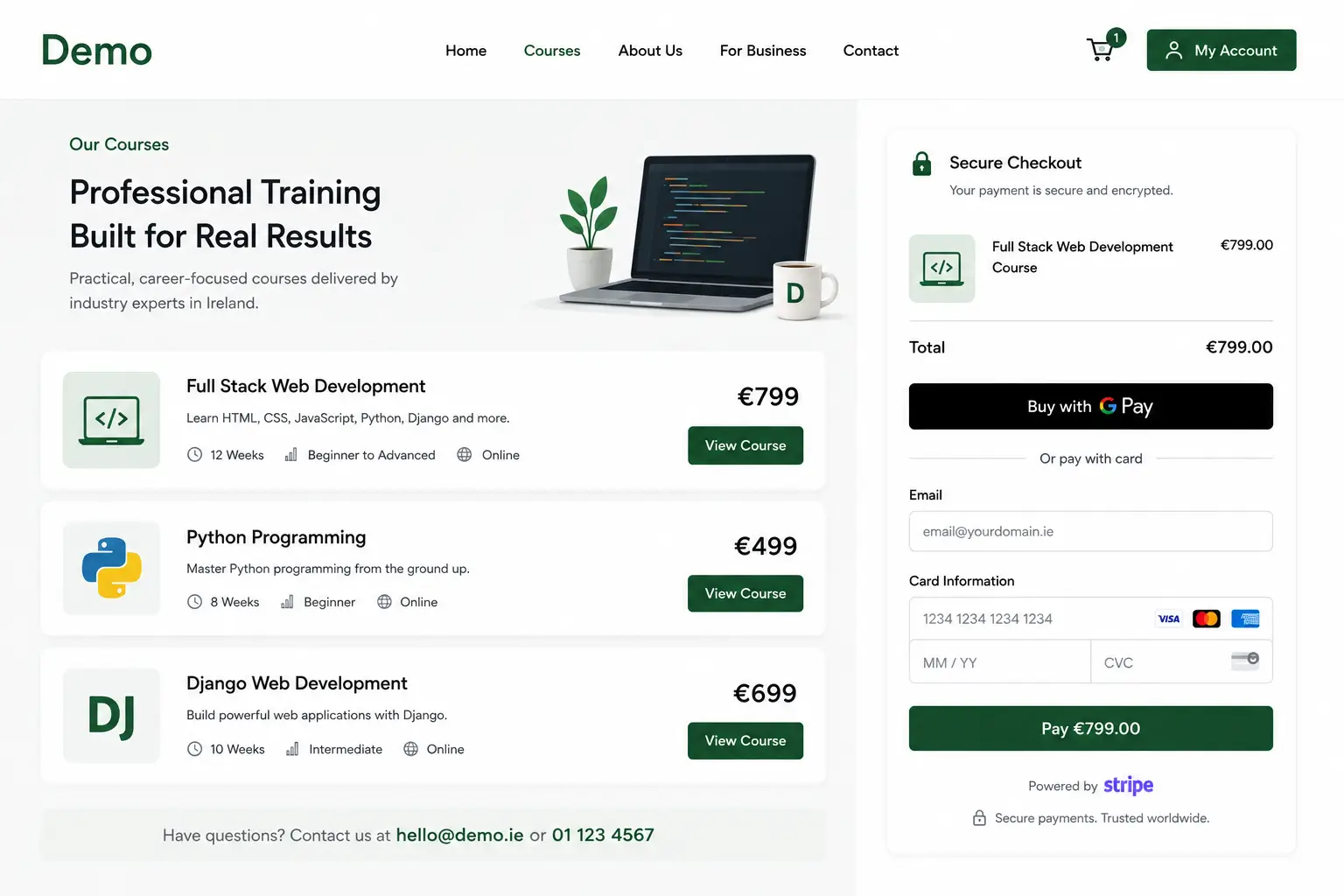
Third, consider a thin custom layer rather than a full replacement. A single screen that your staff use, sitting on top of the systems you keep, often solves eighty per cent of the pain for a fraction of a full build. We did something close to this for course providers, where taking bookings and payments online was the whole job rather than a new back office, and we covered the approach in setting up a course or training website with online payment. Only when those three fail is a full build the right call.
What we have learned building web apps for Irish businesses
Every one of these started as a business running its operations across tools that did not talk to each other. TimeIn replaced manual hour tracking with clock in and out, break tracking and automated payroll calculation, with a self-service portal so staff can see their own hours rather than asking. Finafy consolidated fragmented financial operations into one Django platform with live dashboards and role-based access, so managers stopped waiting on reports to make decisions.
On the retail side, Poisa brought sales, inventory, payroll and purchase orders together for multi-location businesses, which cut transaction times and improved stock control. And Reddy Till is our own product rather than a client project, a browser-based POS with eleven levels of staff permissions and multi-shop management, built to prove a full till can run without proprietary hardware. We publish no user or revenue figures for it, because it is ours and there is no client outcome to report.
The common thread is unglamorous: permissions and reporting are what people actually value once the app is live. Not the clever features. The fact that the right person sees the right screen and the number is the same everywhere.
Get Your Workflow Scoped Before You Commit
We map what your team does now, show you where the hours go, and quote a fixed price with a feature list and a timeline. If a cheaper fix will do the job, we will say so.
Common mistakes Irish businesses make with custom software
Building the org chart instead of the workflow. Projects that start by asking each department what it wants end up as four small apps in a trench coat. Start with the single journey that carries the most value, usually a job or an order from enquiry to payment, and build that end to end before anything else.
Scoping everything up front and building it in one go. A twelve-month first version is a twelve-month bet on assumptions you made in month one. Staged delivery, where you use a working version early and adjust, costs less and lands closer to what you needed. That is why we build in stages and give you a private link to the working app as it goes.
Treating launch as the finish line. An app is a living system. Frameworks get security patches, dependencies age, and an unmaintained app degrades the same way an unmaintained site does, and the failure is just as quiet. Budget for ongoing maintenance and support from day one rather than discovering it in year two.
Hiring on price alone. The cheapest quote usually wins by leaving things out, and you meet them later as change requests. The questions in how to choose a web designer in Ireland apply just as well to a software partner, particularly the ones about who owns the code and who you ring when something breaks.
Forgetting the people who have to use it. If the new system takes more clicks than the spreadsheet, staff will keep the spreadsheet. Watch someone do the job before you design the screen.
How to tell whether the app is actually working
Pick three numbers before you start and measure them again ninety days after launch. Admin hours a week on the process you automated is the clearest one, and you can get it from a two-week time log rather than a tool. Error rate is the second: credit notes, corrected invoices, repeat visits, whatever a mistake looks like in your business. Third, count the inbound calls and emails asking for information the app now shows, since that is the one that frees up the most time.
For anything customer-facing, add the usual web measures on top. Google Search Console and GA4 will tell you whether people find and use the portal, and if the app sits behind a marketing site, that site still needs to do its job, which is where search optimisation keeps earning its keep.
Frequently Asked Questions
How do I know if I need a custom web app or just better software?
If your process is standard, buy software. If your team keeps building spreadsheets beside the software, retyping the same data, or working around it to serve customers your way, you need a custom web app. Our custom web app development service starts with a discovery call to work out which of the two you are.
How much does a custom web app cost in Ireland?
There is no useful list price, because cost tracks the number of user roles, integrations and screens rather than any package. We scope each project and quote a fixed price with a feature list and timeline after a discovery call. The same quoting principles apply as on a website build, which our guide to web design costs in 2026 sets out.
How long does it take to build one?
A focused internal tool that solves one workflow can take a few weeks. A full customer-facing platform with multiple roles, payments and integrations takes longer. We build in stages and give you a private link to the working app as it goes, so you are using something real long before the final handover.
Can a custom web app work alongside the systems we already pay for?
Yes, and that is usually the sensible route. Keep the accounts package and the payroll tool, and build only the part that is genuinely yours, connected to the rest. It costs less than a full replacement and avoids migrating years of financial history. Most business website and app projects we deliver work this way.
Who owns the code once it is built?
You should, and you should get that in writing before work starts. Ask who holds the repository, who controls the hosting account and the domain, and what happens if you move to another developer. Any agency that will not answer those three questions plainly is telling you something, and you should listen to it.
What to do before you brief a developer
Score yourself against the seven signs, write down what the workarounds cost you in hours a week, and try the cheap fixes first. If four or more signs hold and the numbers still point the same way, a custom web app is no longer a luxury purchase, it is cheaper than the status quo. Bring that one page to the conversation and you will get a sharper quote than any feature wishlist would produce.
If you would like a second opinion before you spend anything, we are happy to look at what you have and tell you whether a build is justified. Get in touch with us for a no-obligation conversation and we will tell you what we would do, and what we would not.