Introduction
Somebody has offered you a website for €300. Maybe it's €500 with a year of "free" hosting thrown in. Maybe it's an offshore quote that undercuts every Irish agency you've spoken to by a factor of five. It is tempting, and honestly, it is not always the wrong call. But before you say yes, it is worth working out what that website actually costs once you own it, not just what it costs to build. Why cheap web design costs more over two or three years is not a scare story. It is arithmetic, and it holds up whether you are a sole trader in Cork or a ten-person practice in Dublin.
This is not an argument that you must always spend more. Plenty of businesses are genuinely well served by a cheap or DIY site, and I will say exactly where that is true further down. What this piece does is show you where the hidden costs in a cheap build actually come from, how to put a realistic number on them, and what a fair, professionally built site buys you in return. If you already have a quote in hand and want to know how to read it line by line, our guide on how to evaluate a web design quote in Ireland covers that in detail. This post is about the decision one step before that: whether the price tier you're looking at fits what your business actually needs.
Why a Cheap Website Looks Like the Right Call
It is worth being honest about why cheap offers exist and why so many Irish business owners take them. A €300-500 template site, sold by a local freelancer or an offshore agency working through a marketplace, gets you something live within a week. For a business with almost no starting budget, or one that genuinely does not know yet whether it needs a website at all, that speed and that price are real advantages, not tricks. Nobody wants to spend €2,000 finding out their business idea does not have legs.
The offer usually looks something like this: a handful of template pages with your logo and colours dropped in, a contact form, and hosting bundled in for the first year, sometimes described as "free" even though it is really deferred. The person selling it is not necessarily dishonest. Templated builds genuinely are cheaper to produce, because the same structure gets reused across dozens or hundreds of client sites with minor styling changes. The saving is real. What is less often explained is what that saving is actually trading away, and that is the part worth understanding before you sign anything.
Where the Hidden Costs of a Cheap Website Actually Come From
The real cost of a cheap website comes from six places: no ownership of the code, weak or absent ongoing support, little to no SEO foundation, neglected security and maintenance, design that was never built to convert, and the near-certainty of a full rebuild within a year or two. None of these show up on the invoice you're handed at the start. They show up later, in ways that are easy to underestimate because they don't feel like a single bill, they feel like a slow drip of small frustrations and missed opportunities.
You Don't Actually Own the Site
This is the one that catches people out hardest. A lot of very cheap builds are put together on a locked platform or a proprietary template system that only the original builder can edit. You can't export the code, you can't hand it to another developer, and you can't move hosting providers without starting again from scratch. If the person who built it stops replying to emails, which happens constantly with bargain freelance deals, you are stuck. Not inconvenienced. Stuck. Our post on choosing and buying a domain name in Ireland covers the related and equally damaging version of this problem, where the domain itself gets registered in the builder's name rather than yours.
Support Thins Out Fast
A €300 build has a thin margin, and thin margins do not fund ongoing support. Once the site is live, you're often on your own, or paying per-fix rates that were never mentioned upfront. Small problems, a broken contact form, an image that won't upload, a plugin conflict, sit unresolved for weeks because nobody is contractually obliged to look at them. Compare that with a proper website maintenance and support arrangement, where fixes are part of what you're already paying for rather than a fresh negotiation every time something breaks.
There's No SEO Foundation Underneath It
This is the quiet one, and it's the one that costs the most over time. Cheap template builds are rarely structured with proper heading hierarchy, unique page titles, clean URLs, or a sitemap that actually gets submitted anywhere. Google's own guidance on creating helpful, people-first content is explicit that mass-produced pages spread across a large network of near-identical sites, exactly what a template mill produces at scale, are the opposite of what its ranking systems are built to reward. A site with no SEO foundation does not fail loudly. It just never shows up. You end up paying for Google Ads or boosted social posts indefinitely to get the traffic a properly structured site would have earned for free. Our guide on website structure for SEO in Ireland shows what that foundation actually looks like when it's done from day one.
Security and Maintenance Get Neglected
Nobody is patching plugins, renewing SSL certificates properly, or monitoring for the kind of vulnerabilities that get a site quietly hijacked and used to serve spam or malware. We've written before about what happens when you don't update your WordPress plugins, and the honest answer is: usually nothing, for a long time, and then everything at once. A hacked or broken site does not just cost the fix. It costs the days or weeks it's offline, and whatever trust it burns with customers who land on a broken page or a browser security warning.
The Design Was Never Built to Convert
A template is designed to look acceptable across thousands of unrelated businesses, which means it is designed to offend nobody rather than to convert your specific visitor into an enquiry. Weak calls to action, generic stock photography, no thought given to where a plumber's customer needs a phone number versus where an accountant's client needs a booking link. Our piece on conversion rate optimisation goes into this properly, but the short version is that a site which converts one extra enquiry a month often pays for the difference in build cost within a year on its own.
You Pay for a Full Rebuild Within a Year or Two Anyway
This is where all the above lands. Once the lock-in, the support gaps, the invisible SEO, and the weak conversion design compound, most businesses end up paying for a second build, this time properly, within 18 to 24 months. That second build isn't discounted because you already spent money once. You're paying full price for a site that should have been built properly the first time, and you've lost whatever traffic and enquiries the interim period cost you.
A Realistic Total Cost of Ownership: Cheap Build vs Professional Build Over Three Years
The numbers below are illustrative ranges based on typical patterns we see across Irish small business projects, not a quote for any specific job. Treat them as a way of thinking about the decision, not as a hard price list. A brochure site is used as the example because it's the most common starting point for a small business.
| Cost Component (over 3 years) | Cheap Template Build | Fair Professional Build |
|---|---|---|
| Upfront build cost | €300-€500 | €1,500-€3,000 |
| Hosting and basic upkeep | "Free" year one, then €150-€300/year, often on a locked plan | €150-€300/year, on an account you control |
| Ad-hoc fixes and support | Unpredictable, often per-incident, sometimes unavailable | Included in a maintenance arrangement or billed at a known rate |
| Paid ads to compensate for weak SEO | Often becomes the main traffic source, ongoing spend | Optional top-up rather than a substitute for organic visibility |
| Likely rebuild within 2-3 years | Highly likely, full second build cost | Unlikely if the original scope was right |
| Illustrative total, 3 years | Often €3,000-€6,000+ once a rebuild and paid ads are included | Roughly €2,400-€4,200, largely predictable |
The pattern that matters here isn't the exact euro figures, it's the shape of the curve. The cheap option front-loads a small saving and back-loads a series of larger, less predictable costs. The professional option front-loads a bigger number but flattens out. Whether that trade is worth it depends entirely on what your business needs in year one, which is exactly why this isn't a blanket "always pay more" argument.
Comparing a Cheap Quote Against a Fair One?
Custom Web Design Starting at €1,500 | No Hidden Fees | Free Consultation | Custom, SEO-ready site in 4 weeks (not 12-16)
What a Fair, Professionally Built Website Actually Buys You
Paying a fair price, typically somewhere between €1,500 and €3,000 for a small business brochure site in Ireland, is not about the number being bigger. It's about what that number includes. A proper technical foundation means clean code, sensible page structure, and a build that a different developer could pick up and understand if you ever needed to switch. Real ownership means the domain sits in your name, the code is yours to export, and nobody can hold your own website hostage over a support dispute.
SEO groundwork, done properly from the start rather than retrofitted, means the site has a genuine chance of showing up in search results without permanent ad spend propping it up. Ongoing maintenance and security mean plugins get patched, backups exist, and a broken form gets noticed before a customer does. And design that's actually built to convert means the layout, the calls to action, and the content were thought through for your specific customer, not borrowed from a template used by a plumber, a hairdresser, and a driving instructor in three other counties.
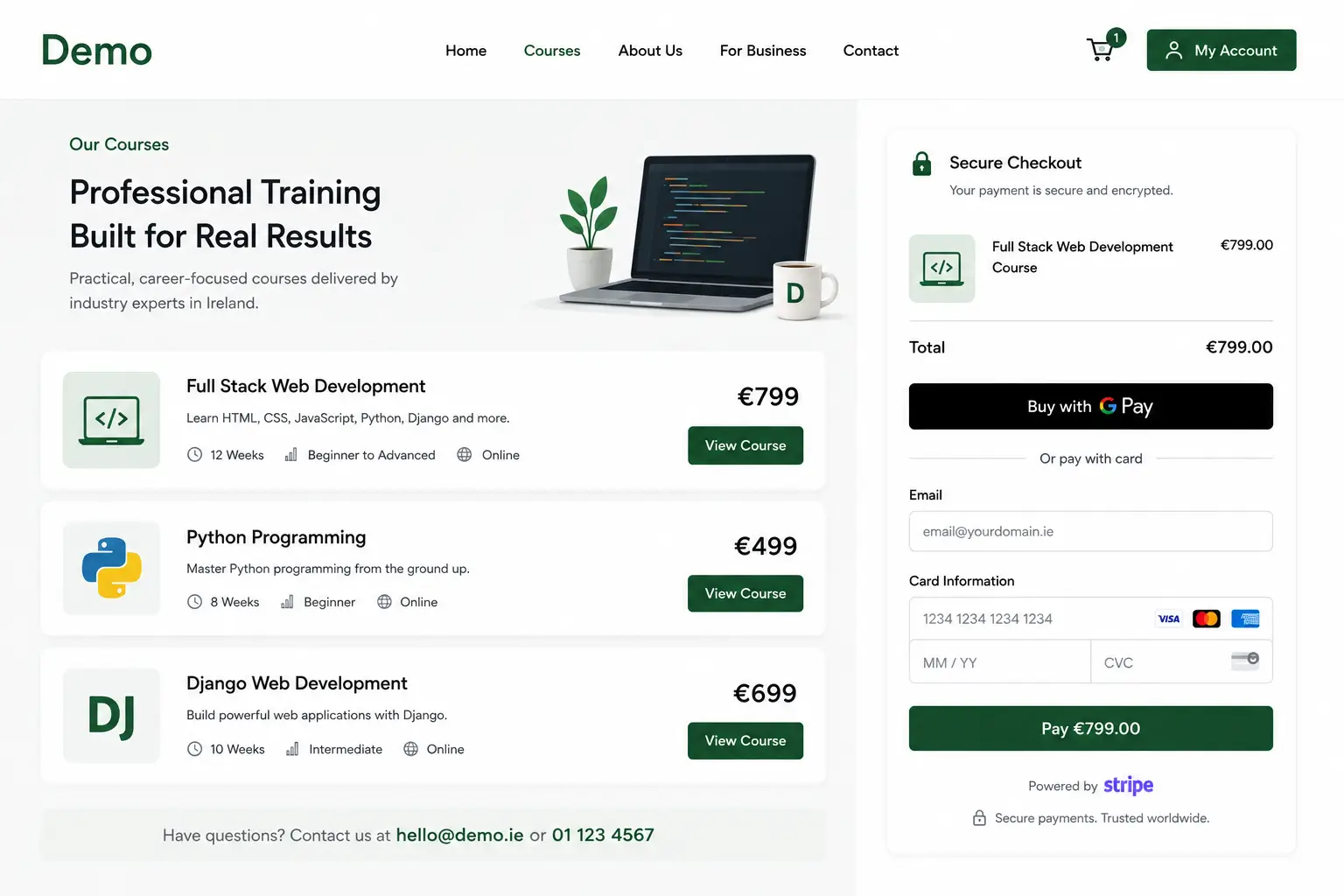
You can see this play out in practice on a real Irish project. When we built the website for Setanta Safety and Training Ltd in Waterford, the business had been running entirely on phone and email, with no way for a construction worker or employer to book a Safe Pass course online. There was no SEO foundation in place either, so the business was effectively invisible for local searches like "Safe Pass Waterford," despite Ken Walsh bringing 35 years of genuine industry experience to the table. We built a WordPress site with a proper technical structure, Stripe payment integration for direct course bookings, and SEO work aimed specifically at the local, high-intent searches a national training provider wasn't bothering to target. None of that would have been possible on a €300 template, not because templates can't look fine, but because they aren't built to carry a payment flow, a booking system, and a genuine local SEO strategy at the same time. The build itself sits on WordPress, so Setanta can bring in any competent developer to extend the site later, not just us. That flexibility is exactly what a locked template build denies you.
When Cheap or DIY Is Actually the Right Call
None of this means every business needs to spend €2,000 in year one. If you're testing an idea before you know whether it has real demand, a cheap or free DIY site is often the smarter move, not the false economy. Spending serious money validating a business that might not exist in six months is its own kind of waste. Equally, a genuine hobby project, a personal blog, a one-off community fundraiser page, doesn't need enterprise-grade SEO groundwork or a conversion-optimised layout. Matching the investment to what the business actually needs cuts both ways: overspending on a site you don't need yet is just as much a misjudgement as underspending on one that's carrying real revenue.
The line to watch for is whether the site is expected to generate income, build search visibility, or represent a business people are trusting with money or personal information. Once any of those apply, the maths in the table above starts to bite, usually faster than people expect. A web designer chosen carefully, at a fair price, stops being an expense and starts being infrastructure.
Mistakes Businesses Make When Weighing Cheap vs Professional
Comparing only the upfront number. The headline price is the easiest thing to compare and the least useful one. A €300 quote and a €2,000 quote are not the same product with different price tags, they are usually two different products entirely, and the comparison needs to reflect that.
Assuming "hosting included" means the site is fully owned. Bundled hosting is often the mechanism that creates lock-in in the first place. Ask directly, in writing, whether you can move the site to a different host and a different developer at any point, not just whether hosting is included in the price.
Treating SEO as something to add later. Retrofitting proper structure, headings, and metadata onto an existing site costs more than building it in from the start, because someone has to first understand and then partially undo what's already there. It is one of the most common and most expensive mistakes we see, and it's why our SEO services are usually cheaper to deliver alongside a new build than as a standalone retrofit six months later.
Not asking who owns the domain. This single question prevents the most damaging outcome on this list. If a builder registered the domain themselves "to make it easier," that ease comes at your expense the day the relationship ends.
Ignoring conversion design because the site "looks nice." A visually acceptable template can still convert poorly. Looking fine and working hard for your business are two different qualities, and a cheap build usually only delivers the first one.
Ready to Build a Site That Doesn't Need Replacing in Year Two?
We build properly structured, SEO-ready websites for Irish small businesses, with real ownership and no lock-in. Get a straight quote before you commit to anything.
How to Tell if Your Own Site Is Already the Expensive Kind of Cheap
If you already have a cheap site and you're wondering whether it's quietly costing you, a few checks take minutes. Search your own business name plus your town or county and see whether you appear. Try editing a page yourself and see whether you actually can, or whether you need to go back to the original builder. Check when the content was last genuinely refreshed, not just re-saved, since our guide on how often you should update your website content covers why stale content quietly drags on both trust and rankings. Check whether your maintenance plan, if you have one, covers plugin and security updates or just cosmetic tweaks. If the site runs slowly as well as looking dated, our piece on how to speed up a WordPress website is worth a read before you assume a full rebuild is the only fix. And look honestly at your enquiry numbers relative to your visible traffic. If people are landing on the site but not getting in touch, that's a conversion design problem, not a traffic problem, and it points at the build itself rather than your marketing.
A website redesign done properly at this stage tends to cost less than most business owners fear, particularly because a genuine content and structure audit, the kind our website redesign strategy and planning guide walks through, avoids paying twice for work that's still usable. Our post on what E-E-A-T is and why Google uses it to rank your website is also worth reading if you suspect thin, template-driven content is part of why you're not being found.
Our Thoughts on Cheap Web Design and Long-Term Cost
The honest answer to why cheap web design costs more is that the price tag was never the full cost, it was just the part you could see on day one. Ownership, support, SEO groundwork, security, and conversion design are all either included or missing at that same price point, and missing them doesn't save you the money, it just moves the bill to later and makes it larger. The right move isn't to assume you always need to spend more. It's to be honest about what your business actually needs right now, and to ask the ownership and SEO questions before you sign, not after. If you're ready to compare quotes properly once you know what to look for, our guide on how to evaluate a web design quote in Ireland is the natural next read. And if you'd rather just talk it through, get in touch with Web Wizard for a straight, no-obligation conversation about what your business actually needs.