Introduction
An instant quote tool lets a customer describe the job on your website and get a price or a price range straight away, with no phone call and no waiting for you to reply. For a simple service with a handful of options, a plugin does this well. Once your pricing depends on area, access, materials, VAT treatment or who is free on which day, a plugin starts to break, and that is when a custom-built tool earns its cost.
This guide is for Irish service businesses that quote jobs: trades, cleaners, removals, installers, mobile services, small professional firms. We'll cover what an instant quote tool does, when an off-the-shelf form is genuinely enough, and the specific conditions where we'd tell you to build it properly. It's a decision guide, not a pitch: plenty of businesses should start with a plugin. If you're weighing the wider question of software versus a build, our guide to signs your business needs a custom web app covers that side.
What an instant quote tool actually does for a service business
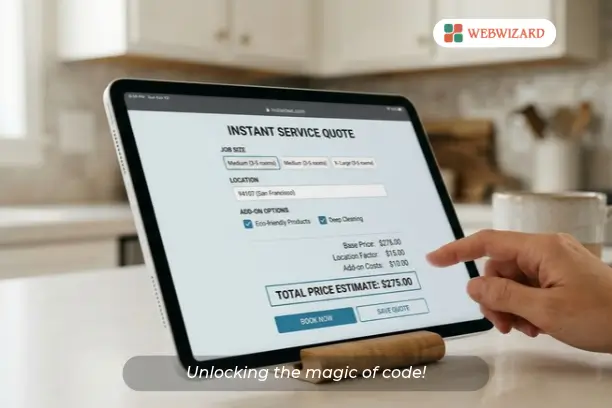
An instant quote tool, also called an online quote calculator or estimate form, takes a few answers from the customer (what, where, how big, when) and applies your pricing rules to produce a figure. The better ones then capture the customer's details and send the quote to you and to them, so the price becomes a lead rather than a screen they close.
Two things matter more than the interface. The first is that the price has to be one you'd honour, or clearly labelled as an estimate with what could change it. The second is that it should shorten the path to a real job. A customer who sees a price range and still wants you is a far better enquiry than one who emailed asking "how much?". That's the same reasoning behind a good service page that converts visitors into enquiries: answer the price question early and the right people stay.
When a plugin or off-the-shelf calculator is enough
Be honest with yourself about how complicated your pricing really is. A plugin, a hosted calculator or a form builder with calculation fields is enough when you can write your pricing on one side of A4 and a new staff member could quote from it without asking you anything.
That usually means a flat price per service, a price per unit (per room, per square metre, per hour) with a minimum charge, and a small number of add-ons that each cost a fixed amount. On a WordPress site, a calculator plugin or a form with calculated fields can handle that in an afternoon, and a hosted tool can sit on any site. If your site is on WordPress, our WordPress website design work often includes exactly this kind of form, and it's cheaper than building anything from scratch.
Plugins also make sense as a test. If you don't know whether your customers will use an online quote at all, run a simple one for a few months before committing to more. Honestly, most small businesses should start here.
Know the trade-off you're accepting, though. Every plugin is one more thing to keep updated, and a quote form that breaks silently after an update costs you enquiries without telling you. What happens when you don't update WordPress plugins explains the risk, and our website maintenance and support plan covers it.
| Your pricing looks like this | Plugin or hosted form | Custom-built tool |
|---|---|---|
| Flat prices, a few fixed add-ons | Enough | Not worth it |
| Price per unit with a minimum charge | Enough | Not worth it |
| Several services, each with its own formula | Strained, gets messy fast | Worth considering |
| Price changes by area, distance or access | Only with workarounds | Usually justified |
| Options that change other options | Rarely supported cleanly | Usually justified |
| Quote must check who is free | Not what these tools do | Justified |
| Quote must flow into your CRM, PDF and booking | Patchwork of connectors | Justified |
Not sure whether your pricing needs a custom tool?
Send us how you price a typical job and we'll tell you honestly whether a plugin will cope. Websites start from EUR 1,500, and custom web app projects are scoped and fixed-priced.
The conditions that call for a custom-built instant quote tool
These are the situations where we see off-the-shelf tools fail. None of them is a reason on its own to build something custom, but two or three together almost always are. The scenarios below are general illustrations of how pricing logic behaves, not client stories.
One service, several variants, each with its own rules
If you offer, say, three services and each is priced by a different formula (one per square metre, one by the hour with a call-out fee, one fixed with materials on top), a single calculator has to be bent into three. Plugins handle this by cloning forms, and every change to your prices then means editing three forms by hand. A custom tool keeps each service's rules separate, so the customer sees only the questions that apply to what they picked.
Area-based pricing and travel charges
Many Irish service businesses charge differently by county, by Eircode area or by distance from the base. A flat price list can't do that. A custom tool can take the customer's Eircode or address, work out the distance or zone, and add the right travel charge or zone price automatically. It can also refuse politely when the job is outside your area, which saves you from quoting work you'd never take.
Conditional options that change the price
This is the most common place a plugin runs out. Access, size, material, urgency and add-ons rarely add a fixed amount. Out-of-hours work might add a percentage to labour but not to materials. A second-floor job might need extra equipment, which is only offered when the job is above a certain size. Choosing one material might make another option unavailable. When answers change which questions appear and how others are priced, you need conditional logic written for your business, not a general rule engine.
Tiered and volume pricing
Price breaks (the first 50 units at one rate, the next at another), bundles and repeat-customer rates are simple to say and awkward to build in a form. Tiers are the textbook case where a custom calculation is cleaner than a stack of workaround fields, and where a mistake quietly under-charges every job.
VAT handled correctly
Ireland has more than one VAT rate, and which one applies to a job depends on the type of work. Revenue publishes the VAT rates database, and your accountant will tell you what applies to each of your services. If a single quote mixes labour at one rate and materials at another, or you quote business customers ex-VAT and households inc-VAT, the tool has to apply the right rate to the right line and show the total the way the customer expects. Getting that wrong in a plugin is easy and expensive.
Availability and capacity checks
An instant price is much more useful if the tool also knows whether you can do the job. Limits on crews, vehicles, daily hours or lead times can be built into the tool so it offers only dates you can actually meet. Plugins that quote don't check a calendar, and booking plugins don't price. Joining them is custom work. Our guide to adding an online booking system covers the booking half on its own.
Quotes that need to feed the rest of your business
A quote that lands in an inbox is a chore. If it needs to create a record in your CRM, produce a branded PDF, send the customer a confirmation, notify the right person and turn into a booking when they accept, you're connecting systems, not filling in a form. That's the point where chains of connectors get fragile and a purpose-built tool, with the quote saved in your own database, is more reliable and easier to trace when something goes wrong.
Staff who can change prices without a developer
The condition people forget until it hurts. Prices change: fuel, materials, a new van, a new area. If changing a rate means editing code or paying someone, the quote tool goes out of date and nobody trusts it. A custom tool should come with an admin screen where whoever is allowed can change rates, zones, add-ons and VAT settings, with different permission levels so one person can't accidentally rewrite everything.
Real work: pricing rules, VAT and staff permissions in a web app we built
We haven't published a case study on a quote calculator specifically, so we won't pretend otherwise. What the closest piece of our work shows is the same building blocks. Reddy Till, the cloud till we built for multi-shop retailers, includes printable Z-reports with a VAT breakdown, PIN-based staff login and 11 granular staff permissions, per its case study. Rules that have to be right, money that has to add up, and different people allowed to do different things: that's the shape of a good quote tool too. Our custom web apps development service is where that kind of work lives.
What an instant quote tool costs in Ireland
Plugin and hosted-tool prices change and vary by vendor, so check the current price of any you shortlist. Add the time to configure it and keep it updated.
For custom work, we don't publish a list price, because the rules decide the cost, not the screen. Our websites start from EUR 1,500, and web app projects are scoped and fixed-priced after a discovery call, with a feature list and timeline in writing. The more of the conditions above you have, the more the tool costs, which is also why writing your rules down first is the cheapest thing you can do. The breakdown of web design costs in 2026 shows where a normal website sits, and how to evaluate a web design quote helps you read whatever you're offered for the build.
Need a quote tool that follows your rules?
If your pricing has zones, add-ons, VAT or capacity limits, we'll scope a tool that matches it and that your staff can edit themselves.
Show a price or a range, and decide before you build
A fixed instant price is the right answer only when you're confident you'd honour it. For anything that depends on a site visit, show a range, say what could move it, and let the tool book the visit. It converts well and protects your margin.
Before you talk to anyone, write down your pricing rules as plain sentences: what you charge, what changes it, what you refuse. If it fits on one page and has no exceptions, buy a plugin. If you keep writing "unless" and "except when", you've found your custom requirements. The same applies to the page that hosts the tool: keep the layout simple and the next step obvious, as our guide on conversion rate optimisation explains.
If you run a trade, our construction and trade website design page shows how we structure sites for quoting-led businesses, and our development process sets out how a build like this runs.
If you'd like a second opinion on whether your pricing needs a custom tool or a plugin will do, we'd be happy to look at it with you. Get in touch with us and send over how you price a typical job.