Introduction
You have 4,000 followers on Instagram, a Facebook page that gets the odd enquiry through Messenger, and a TikTok video that did surprisingly well last spring. So why would you spend money on a website? This is one of the most common questions we hear from Irish small business owners, particularly trades, salons, cafes and independent shops that built their entire audience on social media without ever getting around to building a website. The honest answer is not "social media is bad" or "you must have a website no matter what." It is more specific than that, and it depends on what you are actually trying to achieve. This guide walks through where social media genuinely wins, where it quietly fails your business, and why the two are not actually in competition with each other.
We build both websites and social media strategies for Irish businesses, so we do not have a reason to talk one down to sell the other. What follows is the case as we see it after watching plenty of business owners find out the hard way what an Instagram-only presence cannot do.
Why This Question Matters More in 2026 Than It Did Five Years Ago
Social media has genuinely changed how Irish consumers discover new businesses, particularly in food, beauty, fitness and retail. A well-run Instagram account can build a loyal local following faster and cheaper than almost any other marketing channel, and for a market stall or a home bakery starting out, it is often the right first move. That part is not in dispute.
What has changed is the risk sitting underneath that strategy. Meta has adjusted its algorithms repeatedly over the past few years, and organic reach on a business Facebook page now regularly sits in the low single digits of your total follower count, meaning most of your audience never sees most of your posts. Instagram outages, account suspensions, and sudden policy changes are no longer rare events either. Ask any business owner who has had an account flagged or restricted for no obvious reason how quickly their entire customer pipeline dried up. If your only presence online lives inside apps you do not control, your business is exposed to decisions made by platforms with no obligation to protect your interests. A website removes that single point of failure, because it belongs to you.
Website vs Social Media: What's the Real Difference?
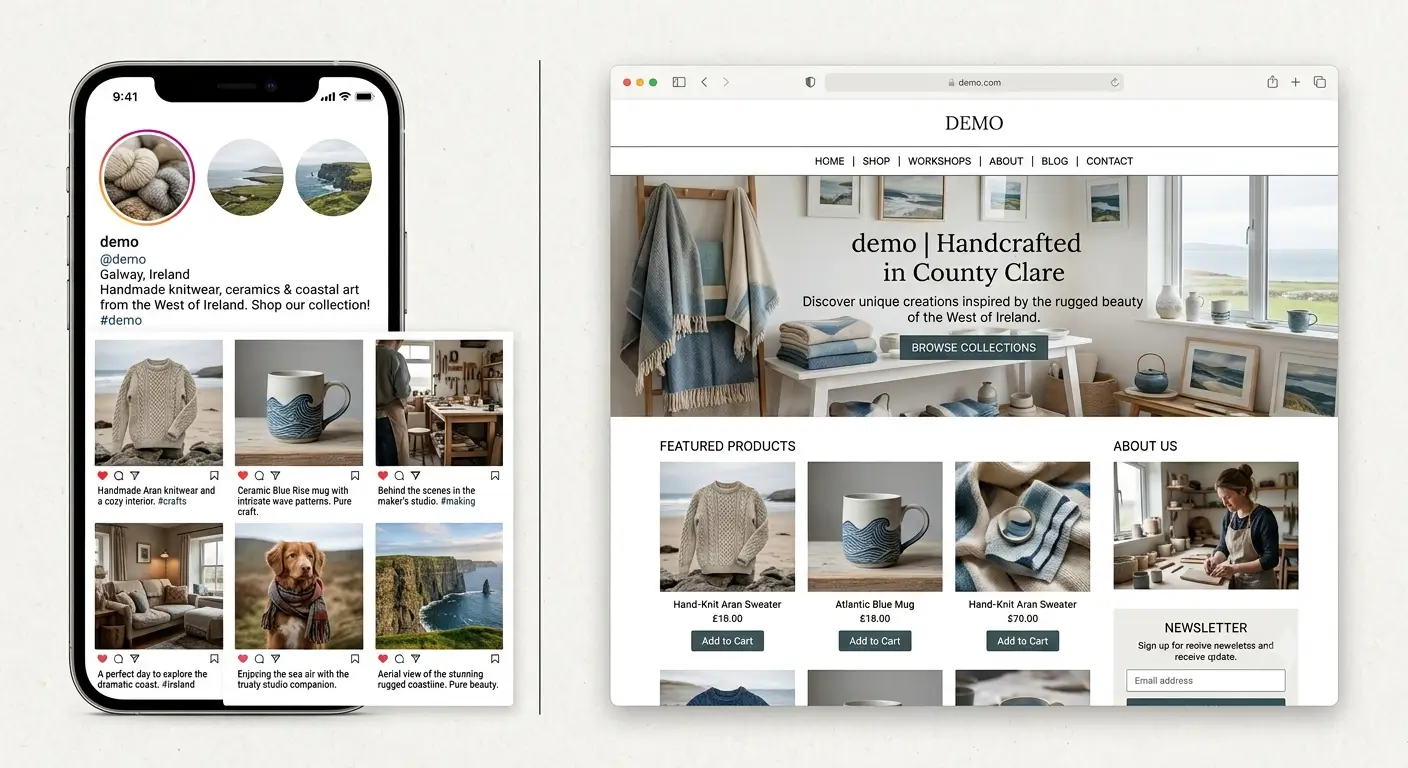
A website is a digital property you own outright: your domain, your content, your design, and your data. Social media is a profile you rent on someone else's platform, subject to their rules, their algorithm, and their uptime. A website is built to be found through search and to convert a visitor into an enquiry or sale, while social media is built to keep people scrolling inside the app. Neither replaces the other; they do different jobs.
That distinction is the whole argument in miniature. Once you separate "reach and engagement" (social media's strength) from "ownership and conversion" (a website's strength), the question stops being either-or and becomes a matter of which job needs doing at each stage of your customer's decision.
Ownership and Risk: You Are Building on Rented Land
This is the argument that tends to land hardest with business owners once they actually think it through. Every post, every follower, every saved message thread on Instagram or Facebook exists inside infrastructure owned by Meta, TikTok's parent company ByteDance, or whichever platform you are using. You do not own any of it. You have permission to use it, on terms that can change without warning.
Accounts get hacked. Pages get banned for policy violations that were never clearly explained. Platforms shut down, get sold, or change their algorithm overnight in ways that gut organic reach for small businesses specifically. None of this is hypothetical scaremongering: it happens to real Irish businesses every year, and when it does, there is often no phone number to ring and no fast route to getting an account back. A website, by contrast, sits on a domain you register and control, hosted wherever you choose, backed up however you decide. If a developer disappears or a hosting provider closes, you can move the whole thing elsewhere because you actually own it. Our guide on how to choose a web designer in Ireland covers exactly this point in more detail, because domain and code ownership should be one of the first questions you ask before you ever sign a contract.
This is also why we build client sites on open, portable platforms rather than closed ones: a website that cannot be exported or moved is only marginally better than a rented social profile.
Discoverability: Google Search and Social Discovery Are Different Jobs
People search Instagram and TikTok to be entertained, inspired, or to follow people and brands they already like. People search Google because they have already decided they want something and are trying to find who can provide it. Someone typing "emergency plumber Dublin 8" or "wedding photographer Galway prices" into Google is a different customer, at a different stage of the buying journey, to someone idly scrolling a For You page.
A well-built website can be found by that second, higher-intent group. A social media profile almost never can, because Google's own search engine cannot fully index the content locked inside Instagram and TikTok apps the way it indexes a public website. If your only presence is a social profile, you are simply invisible to everyone actively searching Google for what you sell, and that is a sizeable share of your potential customers, particularly for higher-value or urgent purchases. Building a site that actually earns that visibility takes proper planning. Our piece on website structure for SEO in Ireland explains how to lay out pages so Google can understand and rank them, and our SEO services page covers what ongoing optimisation looks like once the foundation is right. Google's own SEO starter guide is a useful reference if you want to understand how ranking actually works before spending money on it.
Still Running Your Business on Instagram Alone?
Custom Web Design Starting at €1,500 | No Hidden Fees | Free Consultation | Custom, SEO-ready site in 4 weeks (not 12-16)
Credibility and Trust: Why a Website Still Signals "Real Business"
Research from .IE, the organisation that runs Ireland's national domain registry, found that 84% of consumers say they trust businesses that have their own website, compared with just 36% who trust businesses that rely solely on social media. That is not a small gap. It is the difference between a customer feeling confident enough to book a consultation, pay a deposit, or hand over a card number, and a customer quietly deciding to keep looking.
The reason is fairly intuitive once you say it out loud. Anyone can set up a free Instagram business account in ten minutes with no verification, no cost, and no accountability. A proper website with a registered domain, clear contact details, a privacy policy and consistent branding signals that a business has invested in itself and plans to stick around. For higher-value purchases, professional services, healthcare, or anything involving a deposit or upfront payment, that credibility gap matters even more. A dedicated services site carries a trust burden that a Facebook page simply cannot meet on its own, no matter how good the reviews are.
Control: Design, Checkout, Booking and Your Own Data
On social media, you get the layout Meta or TikTok gives you. Same profile grid, same font, same limited bio field, same platform-controlled checkout if you use their shopping tools at all. You cannot build a proper booking flow with deposit collection, a multi-step checkout with upsells, or a service page that walks a nervous first-time customer through exactly what to expect. You are working inside someone else's product, built for their goals, not yours.
A website removes every one of those limits. You control the layout, the branding, the exact path a visitor takes from landing page to enquiry form or purchase, and, with proper consent, what customer data you collect and how you use it to follow up. If you take bookings, our guide on adding an online booking system to your website shows what that actually looks like in practice, and if you sell products directly, an ecommerce website gives you a checkout you own rather than one routed through a platform that takes a cut and controls the customer relationship. None of that flexibility exists inside an Instagram Shop.
What Social Media Genuinely Cannot Do for Your Business
This is the practical, functional gap that gets skipped in most "you need a website" arguments, so it is worth laying out plainly. The table below compares what a website and a social media profile can actually deliver, feature by feature, rather than in vague terms.
| What you need | Website | Social Media Profile |
|---|---|---|
| Ranking in Google search results | Yes, with proper SEO | No, profiles are not indexed the same way |
| Full ecommerce checkout you control | Yes | Limited, platform-controlled, takes a fee |
| Online booking with deposits | Yes, fully customisable | Basic third-party integrations only |
| Detailed service or product pages | Unlimited, structured for SEO | Caption length limits, no search value |
| Blog or content marketing for long-term SEO | Yes, builds authority over time | Posts disappear from feeds within days |
| Email list building and ownership | Yes, fully owned contact list | No, you only reach followers via the app |
| Protection from algorithm or policy changes | Yes, you control the platform | No, subject to the provider's decisions |
| Community, engagement and quick discovery | Limited | Yes, this is social media's real strength |
Look at that last row carefully, because it matters. Social media is genuinely better at community, engagement and quick discovery than a website is. This is not a one-sided comparison. It is two different tools built for two different jobs, and a business that only has one of them is missing half the picture.
Fictional Case Example: Riverbank Grooming's Instagram Ceiling
Riverbank Grooming, a two-chair dog grooming salon in Kilkenny, built a genuinely strong Instagram following over three years, close to 6,000 followers, mostly from transformation videos and local shares. Bookings came almost entirely through Instagram DMs, which worked fine until the owner discovered that only around a third of new local customers ever found the account in the first place, because people searching "dog groomer Kilkenny" on Google were landing on competitor websites instead. When Instagram briefly restricted the account over a flagged copyright claim on a trending audio clip, bookings stalled for eleven days with no way to reach regular customers who did not follow other channels. After that, Riverbank built a simple five-page website with an online booking calendar and kept Instagram running exactly as before, now used to drive traffic to the site rather than to replace it. Within four months, direct bookings through Google search overtook Instagram DMs as the salon's largest source of new customers.
Turn Your Social Media Followers Into Customers Who Convert
Custom Web Design Starting at €1,500 | No Hidden Fees | Free Consultation | Custom, SEO-ready site in 4 weeks (not 12-16)
The Right Framing: Social Media for Discovery, Website for Conversion
None of this is an argument to abandon social media, and we would tell you that even if we only built websites, because it would be bad advice otherwise. Social media is genuinely excellent at the top of the funnel: building familiarity, showing personality, sharing behind-the-scenes content, and getting your business in front of people who were not actively looking for you yet. That is a real, valuable job, and a website cannot do it nearly as well or as cheaply.
The mistake is stopping there. Every social post, every bio link, every story highlight should be doing double duty: building your following and pushing genuinely interested people back to a website that is built to convert them and keep working for you in Google search long after that post has scrolled out of anyone's feed. A single Instagram post has a shelf life measured in hours. A well-optimised service page can keep bringing in enquiries for years. If your service pages are not built to convert once that traffic lands, you are wasting the work you already put into growing your following. Our social media marketing service is built around exactly this handover: using social platforms to drive qualified traffic to a website designed to close the sale, rather than treating the two as separate, unconnected efforts.
How to Move From Social-Only to Social Plus Website
If you currently run your entire business through Instagram or Facebook, the transition does not need to be dramatic or expensive. Start with a homepage that clearly states what you do, who it is for, and how to get in touch, because a confusing first impression undoes everything else. Our guide on homepage design best practices is a good starting point if you are unsure what that page should actually include.
From there, build out one properly written page per core service or product rather than a single vague "services" list, since these are the pages that actually rank in Google for specific searches. Add a simple, working contact or booking method, whether that is a form, a booking calendar, or a click-to-call button, and make sure every call to action on the site is doing its job; our piece on writing a call to action that actually gets clicked covers the small wording changes that make the biggest difference. Finally, update your Instagram and Facebook bios with the new website link, and start mentioning the site naturally in posts and stories rather than routing everything through DMs. None of this replaces the account you have already built. It gives that account somewhere useful to send people.
Common Mistakes Irish Businesses Make in the Website vs Social Media Decision
Treating Instagram as a full business platform. A bio link and a DM inbox are not a booking system, a checkout, or a searchable service catalogue. Businesses that try to run everything through direct messages lose enquiries to slow replies and missed messages that a proper contact form or booking calendar would have captured automatically.
Building a website once and never touching it again. A site that launches and sits untouched loses relevance in Google's eyes within months, particularly if competitors are publishing fresh content regularly. Our post on how often you should update your website content explains what tends to go stale first and why ongoing website maintenance matters more than most business owners expect.
Ignoring on-page SEO because "Google is complicated". You do not need to become an SEO specialist to get the basics right: clear page titles, one keyword focus per page, and a logical menu structure. Our advanced SEO tactics for Irish businesses guide breaks this down without the jargon, and understanding what E-E-A-T is and why Google uses it will explain why generic, thin content rarely ranks regardless of how nice the design looks.
Making the website harder to use than the Instagram profile it is replacing. If a visitor cannot find your phone number, opening hours, or booking link within a few seconds, they will leave and go back to scrolling. Our guide on what makes a website user-friendly in Ireland and our piece on structuring your menu for conversions both cover the basics that get skipped when a site is built in a rush.
Assuming AI search changes the calculation. Some business owners now ask whether AI tools like ChatGPT or Google's AI Overviews replace the need for a website altogether. They do not; if anything, these tools pull their answers from well-structured websites, not social profiles, which makes a properly built site more relevant, not less. Our post on AI and web design in Ireland covers this shift in more depth.
Making the Decision for Your Own Business
If you take one thing from this guide, make it this: the question was never really "website vs social media." It is "what job does each one need to do for my business, and am I currently missing one of them." Social media builds awareness and community cheaply and quickly. A website gives you ownership, Google visibility, credibility, and a conversion path you fully control. Businesses that only have one are leaving the other's strengths untapped, and for most Irish small businesses still running on Instagram or Facebook alone, the website is the missing half.
If you are ready to give your social following somewhere proper to land, we would be glad to talk through what a first website should include for your business. Get in touch with Web Wizard for a no-obligation conversation, or browse our business website design service to see how we approach projects for businesses exactly like yours.