Introduction
If your website ranks fine for your brand name but stalls everywhere else, the basics are not your problem. You have probably already sorted your title tags, written some blog posts, and claimed your Google Business Profile. The next level of advanced SEO tactics for Irish businesses is less visible and far less forgiving: keyword cannibalization quietly splitting your rankings, crawl budget being wasted on pages nobody needs, weak E-E-A-T signals undermining content that is actually good, and topical authority that never quite forms because your content is scattered rather than connected. This guide walks through all four, with the actual diagnostic steps, not just the theory.
We work with Irish businesses across healthcare, trades, professional services, and ecommerce, and the pattern repeats constantly. A site has fifteen decent blog posts and three competing service pages, all reasonably well written, yet traffic has flatlined for a year. The fix is rarely "write more content." It is almost always one of these four structural issues, hiding in plain sight in Google Search Console if you know where to look.
Keyword Cannibalization: When Your Own Pages Compete Against Each Other
Keyword cannibalization happens when two or more pages on your website are optimised for the same or very similar search term, so they compete against each other in Google's results instead of one page winning a clear position. It is one of the most common and most overlooked advanced SEO tactics for Irish businesses to address, because it does not look like a problem from the outside. The site looks fine. There is just no single page Google trusts enough to rank well.
What Keyword Cannibalization Actually Means
Keyword cannibalization occurs when multiple pages on the same domain target an identical or near-identical keyword, forcing Google to choose between them rather than ranking one clearly. The result is usually that none of the competing pages rank as highly as a single consolidated page would, because backlinks, internal links, and click data get split across several URLs instead of building up one strong page.
We see this constantly with Irish service businesses. A plumbing company in Galway might have a homepage mentioning "emergency plumber Galway," a dedicated service page targeting the same phrase, and an old blog post from two years ago covering "what to do when your boiler breaks down in Galway" that also happens to rank for the same query. Google has three reasonable candidates and no clear winner, so it hedges by ranking all three somewhere around position nine or ten instead of one of them at position three.
Why It Matters More for Irish Businesses Specifically
Ireland's local search market is smaller and more concentrated than the UK or US, which means the gap between position three and position nine for a town-specific term can be the difference between a steady stream of enquiries and almost none. Cannibalization is particularly common on Irish business sites because so many are built around location-plus-service phrasing: "web design Cork," "physiotherapy Athlone," "accountant Mullingar." It is very easy to end up with a homepage, a location page, and a service page all chasing the same three words without anyone intending it.
The cost is not just a missed top spot. Cannibalized pages also confuse the click-through data Google uses to refine rankings over time, because traffic gets split between URLs rather than concentrating on the page that should be improving fastest. If you are running paid campaigns alongside organic, this also muddies your SEO services reporting, because it becomes hard to tell which page is actually driving enquiries.
How to Diagnose Cannibalization Using Google Search Console (Step by Step)
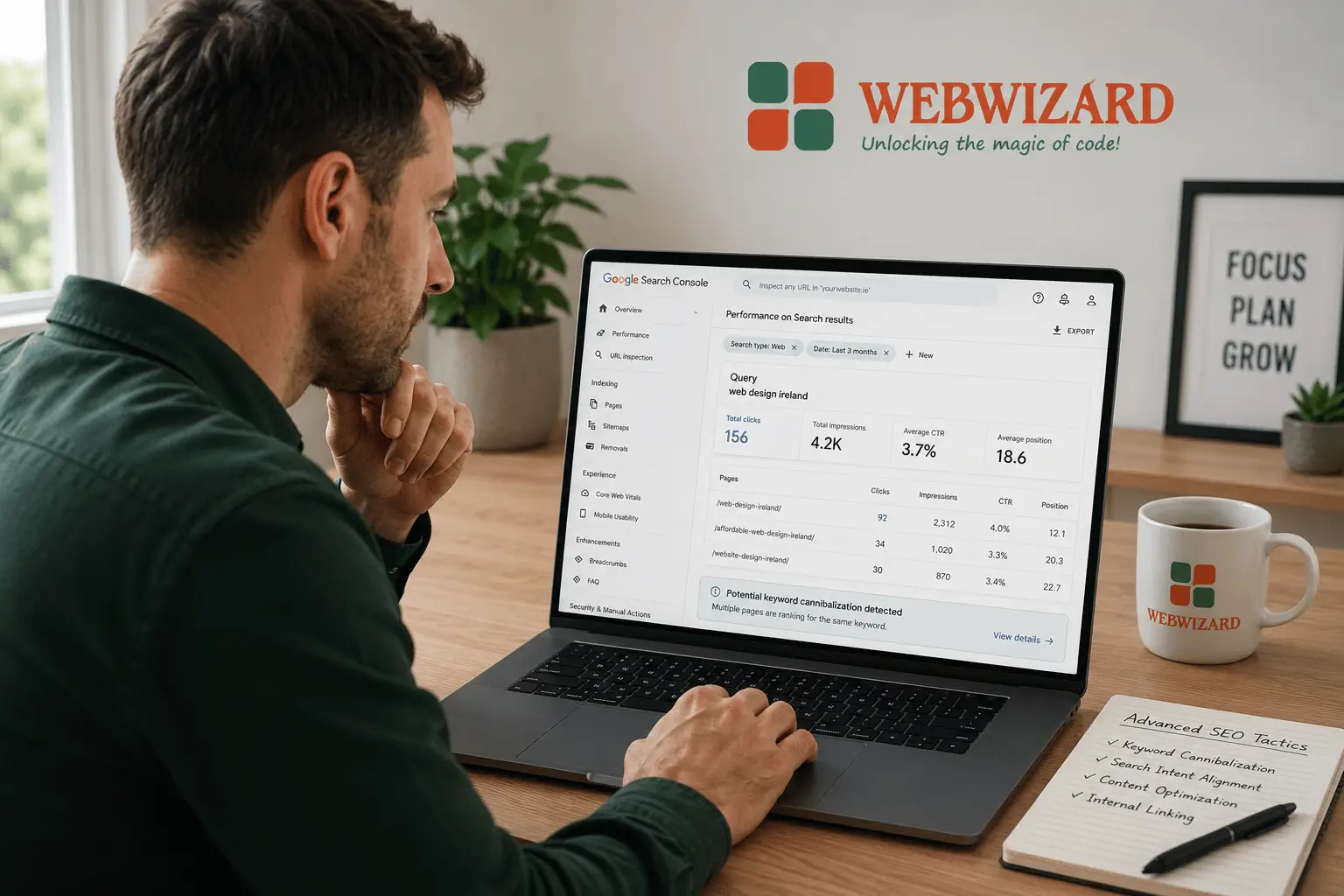
This is the part most SEO guides skip. Open Google Search Console and go to Performance, then Search Results. Filter by "Pages" and set the date range to the last three months. Pick a primary keyword you care about and add it as a query filter. Now switch the breakdown back to "Pages." If you see two or more URLs both receiving meaningful impressions for that query, you have cannibalization. Export the data to a spreadsheet if you are checking multiple keywords, since doing this one term at a time across twenty target phrases gets tedious fast.
A second, quicker check: run a Google search using site:yourdomain.ie "your target phrase" and look at how many of your own pages appear in the results. If three of your own URLs show up for the same exact phrase, that confirms what Search Console suggested. Ahrefs and Semrush both have cannibalization reports under their site audit tools if you want this automated across your whole site rather than checked term by term, which is worth doing once you have more than thirty or forty indexed pages.
Fixing It: Consolidate, Don't Just Delete
Once you find overlapping pages, decide which one deserves to be the authoritative version, usually the page with more backlinks, more historical traffic, or the clearer commercial intent. Merge the useful content from the weaker page into the stronger one, then 301 redirect the old URL to the surviving page. Update every internal link across your site that previously pointed to the redirected page so they point to the new one directly, rather than relying on the redirect to carry the link equity. Do not simply delete the weaker page and hope for the best. A clean redirect with consolidated content typically resolves cannibalization within six to twelve weeks of Google re-crawling and re-evaluating the surviving URL.
If the two pages genuinely serve different intents, such as a transactional service page versus an informational blog post explaining the same topic, the fix is different: refocus one of them on a more specific long-tail variant rather than merging them. A website design service page can target "website design Dublin" directly, while a related blog post can target "how much does website design cost in Dublin," which removes the overlap without losing either page.
Not Sure Why Your Rankings Have Stalled?
Custom Web Design Starting at €1,500 | No Hidden Fees | Free Consultation | Custom, SEO-ready site in 4 weeks (not 12-16)
Crawl Budget: Why Most Irish SMEs Don't Have the Problem They Think They Do
Crawl budget gets discussed online with a level of urgency that does not match reality for most small business websites, and it is worth saying this plainly: if you run a typical Irish brochure site or service business website with under a few hundred pages, you almost certainly do not have a crawl budget problem. Google's own Gary Illyes has said publicly that crawl budget is not something most publishers need to worry about unless they are managing sites with thousands of URLs. Treating this as an urgent fix for a twenty-page plumbing website is wasted effort.
What Crawl Budget Actually Means
Crawl budget is the number of pages Googlebot is willing and able to crawl on your site within a given period, based on your site's crawl rate limit (how fast your server can handle requests without strain) and crawl demand (how much Google actually wants to revisit your pages based on their perceived value). Google's official documentation on managing crawl budget states clearly that this is a consideration primarily for large sites, generally those with over a million pages, or sites with frequent content changes in the tens of thousands of pages range.
When It Actually Matters for an Irish Business
The exception is ecommerce. A Shopify or WooCommerce store with thousands of SKUs, colour and size variants each generating their own URL, and faceted filtering that creates near-infinite combinations of category and filter URLs can absolutely run into genuine crawl budget issues. So can any site suffering a severe technical problem, such as an infinite redirect loop, a broken pagination setup generating tens of thousands of junk URLs, or a WordPress install with plugin-generated archive pages multiplying out of control. If you run a Shopify store with several thousand product variants, or an ecommerce site with extensive faceted navigation, this section is genuinely relevant to you. If you run a service business with eighty pages, it mostly is not, and you should spend your time on cannibalization and content quality instead.
How to Check If Crawl Budget Is Actually Limiting You
Rather than guessing, check Google Search Console's Crawl Stats report under Settings. Look at total crawl requests over the last 90 days and compare that to your total page count. If Googlebot is making far fewer requests than you have pages, and your important pages show "Discovered, currently not indexed" or "Crawled, currently not indexed" in the Page Indexing report, that is a genuine signal worth investigating. For the vast majority of small Irish business sites, this report will show Google crawling comfortably more pages than the site actually has, which confirms crawl budget is not the bottleneck.
For sites where it is genuinely relevant, the fixes are specific rather than vague. Noindex thin tag and category archive pages that add no unique value. Use canonical tags consistently on faceted navigation URLs so Google understands which version is the one to index. Fix any redirect chains, since each hop in a chain costs crawl budget for no benefit. Submit a clean XML sitemap containing only the URLs you actually want indexed, and remove old, thin, or duplicate pages from it. Reducing server response time also helps, since faster servers let Googlebot crawl more pages within the same time allowance, which connects directly to broader WordPress speed optimisation work most sites should be doing anyway.
| Site Type | Typical Page Count | Crawl Budget Risk |
|---|---|---|
| Local service business (plumber, solicitor, clinic) | 10 to 100 pages | Very low, rarely worth investigating |
| Content-led business with a regular blog | 100 to 500 pages | Low, monitor Crawl Stats occasionally |
| Small ecommerce store | 500 to 3,000 pages | Moderate if faceted navigation is uncontrolled |
| Large ecommerce or marketplace | 5,000+ pages | Genuine risk, worth active management |
E-E-A-T: Building Trust Signals Google Can Actually Verify
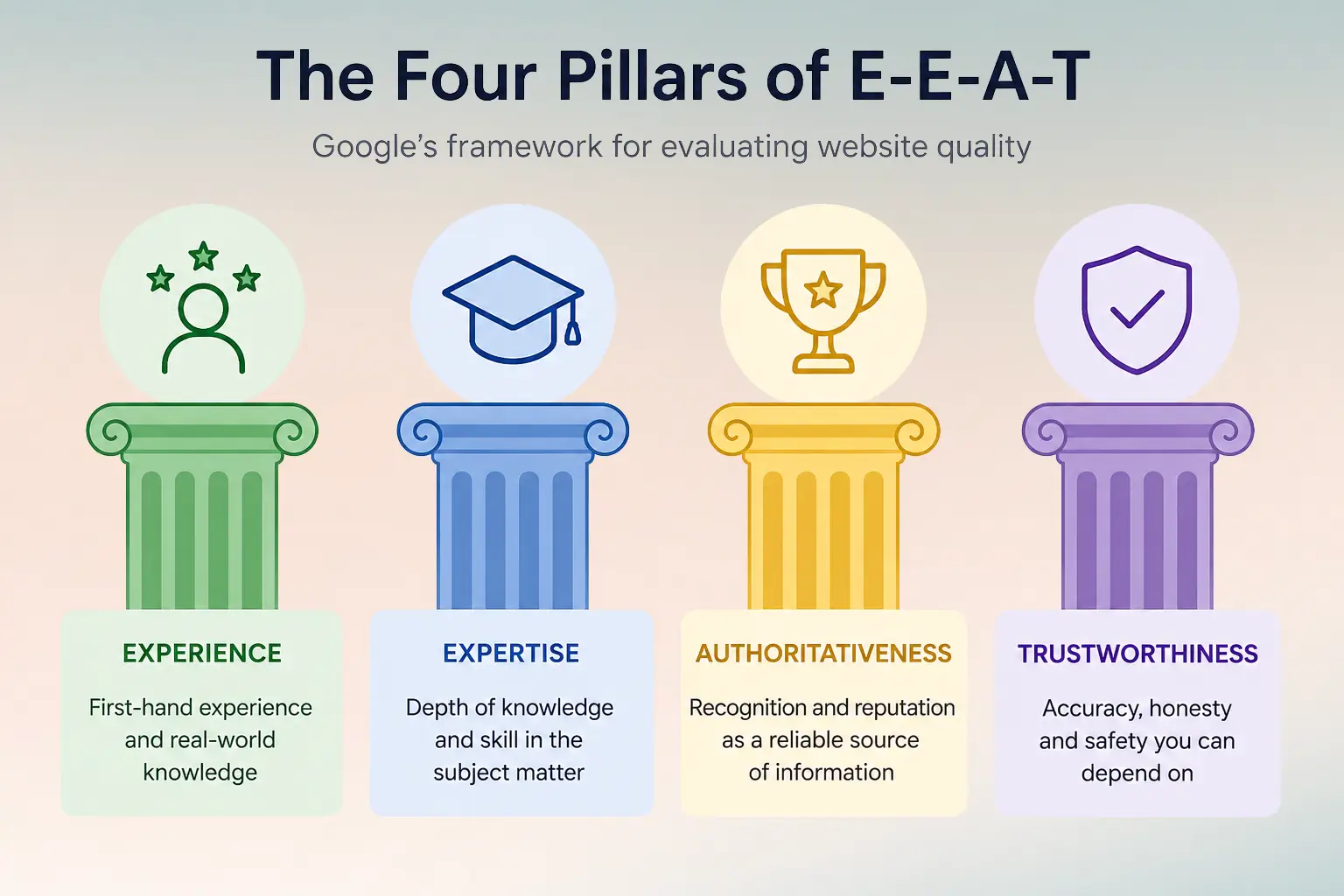
E-E-A-T stands for Experience, Expertise, Authoritativeness, and Trustworthiness, the framework Google's quality raters use to judge whether a page deserves to rank, particularly for topics affecting health, money, or safety. We have covered the full framework and how it interacts with site structure in detail in our guide on what E-E-A-T is and why Google uses it to rank your website, so this section focuses specifically on the practical, executable tactics rather than re-explaining the theory.
Why E-E-A-T Carries More Weight for Irish Businesses Than People Assume
Google applies a category called YMYL, "Your Money or Your Life," to pages whose content could affect someone's health, finances, or safety, holding them to a stricter trust bar. This is directly relevant to a large share of the Irish SME market. Healthcare websites, solicitors, and financial advisors are scrutinised far more closely than a graphic designer's portfolio site, and a generic "our team" page with no qualifications listed will hold these businesses back regardless of how good the actual service is.
Practical Tactics That Move the Needle
Start with authorship. Every meaningful piece of content should carry a named author with a real bio, a professional photo, and a link to a LinkedIn profile or relevant credential. If you run a GP practice or dental clinic, list IMC or dental council registration numbers directly on the about page rather than burying them in a PDF. For accountants, list ACCA, ACA, or CPA membership clearly rather than a vague "qualified team" statement.
Second, fix your About Us page if it is generic stock copy. This single change influences Expertise and Trustworthiness more than almost anything else you can do in an afternoon. Third, keep content genuinely current rather than leaving outdated guidance live, which our piece on how often you should update your website content sets out with realistic timeframes rather than a vague "keep it fresh" instruction. Fourth, earn external validation properly: genuine client reviews, real partnerships, and digital PR coverage build Authoritativeness far more durably than purchased backlinks ever will, a point we expand on in whether off-page SEO is still effective for Irish businesses.
None of this requires a website rebuild. A solicitor's practice that adds named partner bios with Law Society membership numbers, replaces stock photography with real office photos, and publishes one properly researched article a month on a genuinely relevant legal topic will typically see measurable improvement in three to four months, not because of any single dramatic change but because each fix removes a small reason for Google to hesitate.
Topical Authority: Why Twenty Connected Articles Beat One Brilliant One
Topical authority is the degree to which Google recognises your website as a comprehensive, reliable source on a specific subject area, built through depth of coverage and deliberate internal linking rather than a single standout piece of content. A site with one excellent 3,000-word guide and forty unrelated, thin articles has weaker topical authority than a site with twenty solid, well-connected articles all covering one subject area from different angles.
What This Looks Like in Practice for an Irish Business
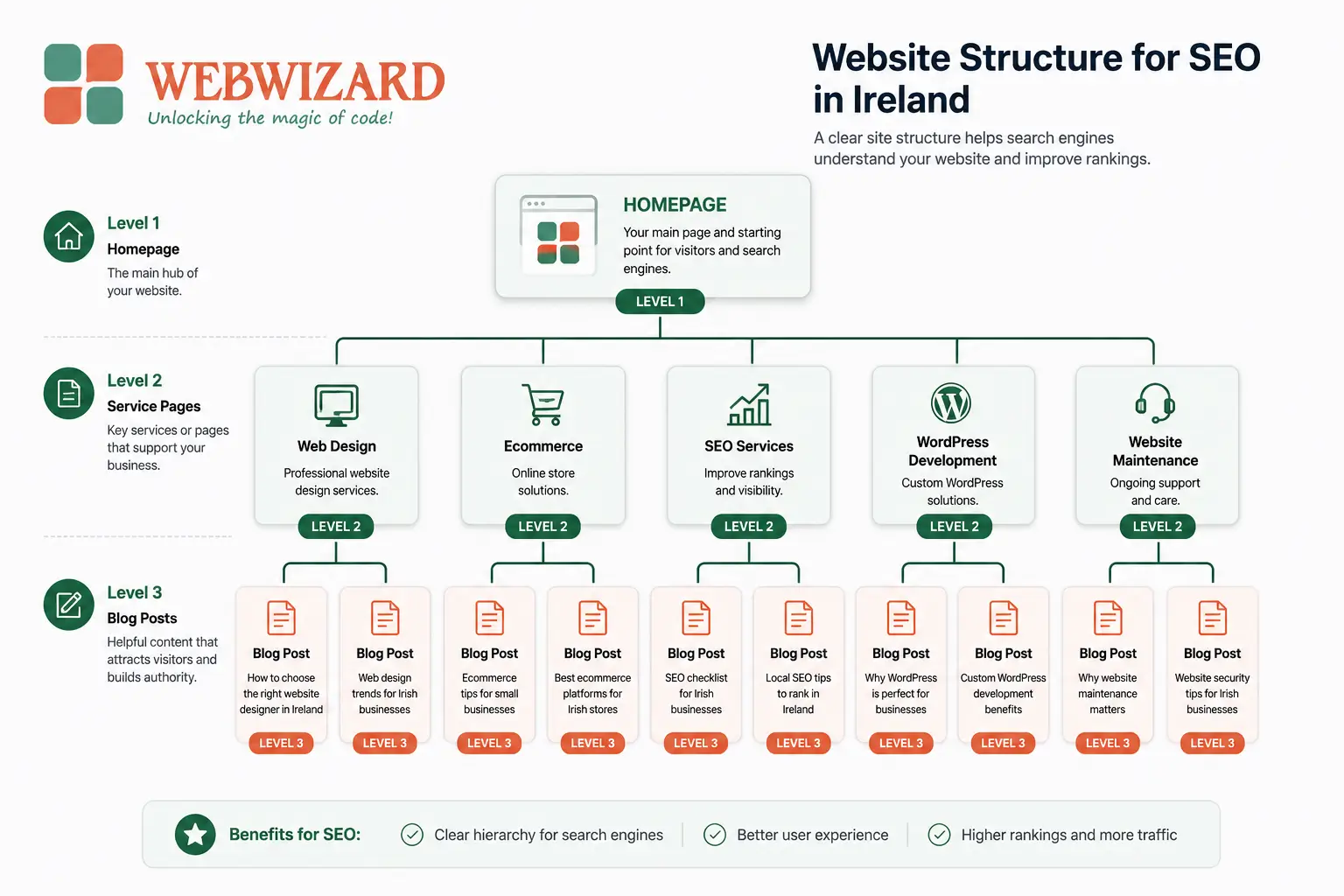
Topical authority is built using a hub-and-spoke structure: one comprehensive pillar page on the core subject, surrounded by several supporting articles that go deeper into specific subtopics, all interlinked in both directions. This is not abstract theory. Good site structure for SEO depends on planning this deliberately rather than publishing whatever topic comes to mind that month.
Consider how this would work for a fictional Irish physiotherapy clinic. The pillar page might be a comprehensive guide to physiotherapy treatment in Ireland, covering conditions treated, what a first session involves, and typical recovery timeframes. Supporting spoke articles would then go deeper on specific conditions: sports injury rehabilitation, lower back pain treatment, post-surgery physiotherapy, and workplace injury recovery. Each spoke links back to the pillar page, and the pillar page links out to each spoke in the relevant section. Within six months, Google typically begins recognising the clinic's whole subdomain as a credible source on physiotherapy generally, not just for the exact phrases used in any single article, because the topical breadth and internal linking pattern signal genuine depth rather than a single isolated post chasing one keyword.
Building It Without Publishing for the Sake of Publishing
Map five or six core subjects genuinely relevant to your business before writing anything else. For a builder, that might be extensions, renovations, new builds, planning permission guidance, and building regulations compliance. For a personal trainer, it might be weight loss coaching, strength training, nutrition guidance, and injury prevention. Commit to covering each subject properly with two or three articles before moving to the next subject area, rather than scattering one article per topic across ten unrelated subjects. This is also why a thoughtful website redesign should preserve and strengthen existing topical clusters rather than flattening URL structure for purely visual reasons, something covered in more detail in our website redesign strategy and planning guide.
For ecommerce specifically, topical authority shows up differently. A Shopify store selling outdoor gear builds authority through genuinely useful buying guides linked to the relevant category pages, not generic product descriptions copied from a supplier. Strong product description writing that answers real buyer questions feeds directly into the same topical signal Google is looking for at category level.
Want a Site Built to Support Topical Authority From Day One?
Custom Web Design Starting at €1,500 | No Hidden Fees | Free Consultation | Custom, SEO-ready site in 4 weeks (not 12-16)
Putting It All Together: A Practical Audit Checklist
These four tactics are not separate projects to tackle in isolation. They reinforce each other, and the order you address them in matters. Start with cannibalization because it is the fastest to diagnose and fix, then move to crawl efficiency if your site size warrants it, then authorship and trust signals, then topical depth, since each step makes the next one more effective rather than working against it.
| Step | What to Check | Tool |
|---|---|---|
| 1. Cannibalization audit | Multiple URLs ranking for the same query | Google Search Console Performance report |
| 2. Crawl efficiency check | Crawl requests versus total page count | Search Console Crawl Stats and Page Indexing |
| 3. Authorship and trust review | Named authors, qualifications, About page accuracy | Manual site review |
| 4. Topical cluster mapping | Core subjects covered with internal linking between them | Spreadsheet content map |
Fictional Case Example: Consolidating a Cork Accountancy Practice's SEO
Fictional Case Example: GreenLeaf Accountants, a fictional three-partner practice in Cork, had a homepage targeting "accountant Cork," a service page targeting "small business accountant Cork," and a blog post from 2021 covering "how to choose an accountant in Cork," all three competing for nearly identical traffic. None ranked above position seven. The team merged the blog post's genuinely useful content into the service page, redirected the old URL, and added named partner bios with ACCA membership numbers to the about page. They then mapped four core topics, tax deadlines, bookkeeping for sole traders, VAT registration, and payroll services, and committed to two articles per subject over the following four months. By month five, the consolidated service page reached position two for the target term, and organic enquiries from the website had roughly doubled compared to the same period the previous year.
Common Mistakes Irish Businesses Make With Advanced SEO Tactics
Fixing Crawl Budget Before Checking If It's Actually a Problem
Plenty of small business owners read an alarming blog post about crawl budget and spend money "optimising" it for a forty-page website that Google was crawling completely anyway. Check the Crawl Stats report first. If Google is comfortably crawling more pages than you have, this is not where your time should go.
Deleting Cannibalized Pages Instead of Redirecting Them
Removing a competing page without a 301 redirect throws away whatever backlinks and authority it had built up. Always redirect to the surviving page and update internal links to point there directly, rather than relying on the redirect alone to carry the signal forward.
Adding a Team Page With First Names Only
A "Meet the Team" page listing first names with no qualifications, registration numbers, or photos does very little for Expertise or Trustworthiness. Google's quality raters are trained to look for verifiable specifics, and vague bios that could describe anyone are not doing the job they appear to be doing.
Publishing Content Across Unrelated Topics With No Internal Linking
One article about ecommerce, one about accessibility, and one about local SEO, with no links connecting them, signals breadth without depth. Topical authority rewards a manageable number of subjects covered thoroughly over scattering effort across everything at once.
Treating a Redesign as Purely Cosmetic
Businesses regularly redesign for visual reasons and accidentally restructure URLs without redirects, losing years of accumulated ranking signals on key pages. Any redesign should map old URLs to new ones properly and preserve the pages already carrying authority, rather than starting from a blank slate.
Where These Tactics Fit Into Your Wider SEO Strategy
None of these four tactics work well in isolation. A site built on solid WordPress foundations with clean code gives Google fewer technical reasons to waste crawl budget. A properly planned website design project avoids creating duplicate category pages that cause cannibalization before launch. Comparing on-page SEO and off-page SEO, you will notice E-E-A-T draws on both: on-page authorship and structure build Expertise directly, while off-page signals like genuine reviews and mentions build Authoritativeness. Regular website maintenance keeps content fresh, which itself is a signal Google's systems weigh when assessing how current your expertise actually is.
For businesses managing multiple location pages, such as a practice with branches across Mullingar and Athlone, cannibalization between location pages is a particularly common version of this problem and worth checking specifically, since each location page should target genuinely distinct local search intent rather than near-duplicate copy with the town name swapped.
Most Irish businesses can make real progress on all four of these fronts within a single quarter without rebuilding their website. Fix the cannibalization first since it is the quickest win, check crawl efficiency honestly rather than assuming it is a problem, add real names and credentials to your trust pages, and map out your subject clusters before writing another word of content. The technical complexity behind Google's ranking systems does not need to become your daily concern. Getting these four fundamentals right consistently is what actually shifts rankings over time.
If you want an honest assessment of where your site stands across all four of these areas, get in touch with Web Wizard for a no-obligation conversation. We will look at your current site structure, your indexed pages, and your trust signals, and tell you plainly what is worth fixing first and what genuinely is not a priority yet.