Introduction
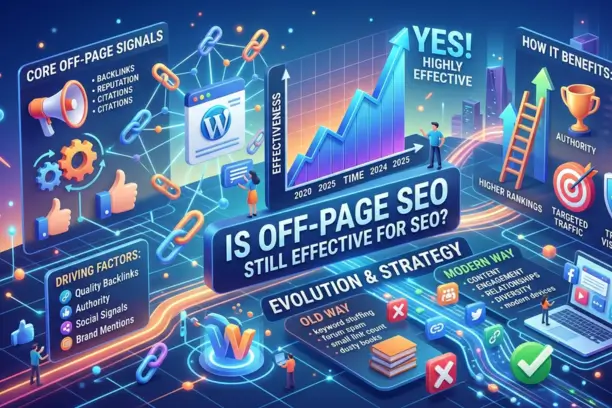
Every few years, someone declares that backlinks are dead. That off-page SEO no longer matters. That Google has moved on. And every time, the data says otherwise. Off-page SEO in Ireland is still one of the most reliable ways to build genuine search visibility - but the way you approach it in 2026 looks quite different from what worked five years ago. If you are running a business website and wondering whether the effort involved in building authority outside your own pages is actually worth it, this guide gives you a straight answer. If you are looking for our different types of website design, visit Website Design Dublin
We will cover what off-page SEO actually involves, why it still matters for Irish businesses, which tactics are worth your time right now, and the mistakes that waste budget without producing results. No filler, no hedging.
What Off-Page SEO Actually Means (and Why Most Definitions Miss the Point)
Off-page SEO refers to every action you take outside your own website that influences how Google and other search engines evaluate your authority, credibility, and relevance. The most well-known element is backlinks - links from external websites pointing to pages on yours. But the full picture is broader than that.
Off-page SEO includes your backlink profile, yes. It also includes brand mentions (both linked and unlinked), local citations in business directories, digital PR coverage in publications, social signals, and the broader pattern of how your brand appears across the internet. When Google is deciding which site to rank first for "solicitors in Galway" or "accountants Dublin", it does not rely only on how well those sites are optimised on-page. It also weighs up how much the wider web appears to trust and reference each one. That is what off-page SEO addresses.
The short answer to whether it still works: yes, clearly. Backlinks remain one of the most heavily weighted ranking signals in Google's algorithm. A 2026 analysis by Backlinko confirmed that links from authoritative, relevant domains continue to be among the strongest predictors of first-page rankings. For Irish businesses competing in local and national searches, a strong off-page strategy is often the difference between page one and page three.
Why Off-Page SEO Matters More for Irish Businesses Than Generic Guides Suggest
Most content on this topic is written for a global or US-based audience. The advice is sound in principle, but it misses several factors that are specific to the Irish market.
Ireland is a relatively small market. That means there are fewer high-authority Irish websites linking out to local businesses compared to, say, the UK or the US. It also means that a single strong link from a credible Irish source - a national newspaper, a well-known industry body, a popular local blog, or an authoritative Irish directory - carries disproportionate weight when you are competing for localised keywords. A link from the Irish Times business section or the Local Enterprise Office website is worth far more in an Irish search context than fifty links from generic offshore directories.
It also means that competition thresholds are lower in many niches. An Irish plumber in Waterford does not need 300 backlinks to rank well. Fifteen to twenty genuinely relevant, high-quality links from trusted local and national sources, combined with solid on-page foundations, can be enough to dominate a regional search. This is actually good news for small businesses: you do not need a six-figure link-building budget. You need a focused, consistent approach aimed at the right sources.
If you are still building the foundations of your site's SEO, our SEO optimisation service for Irish businesses covers both on-page and technical SEO as a starting point before any off-page work begins.
Which Off-Page SEO Tactics Still Work in 2026
Not all off-page tactics are equal. Some have stayed consistently effective. Others have degraded in value as Google has become better at detecting manipulation. Here is a clear breakdown of what is worth your time.
Earning backlinks through genuinely useful content
The most durable link-building strategy is also the most obvious one: publish content that other websites want to reference. Detailed guides, original research, useful tools, or genuinely comprehensive resources attract links naturally over time. An Irish accountancy firm that publishes a clear, accurate guide to the current R&D tax credit scheme will pick up links from SME blogs, startup forums, and business publications without needing to email anyone. The key word is "genuinely useful" - thin or promotional content does not earn links.
Digital PR and media coverage
Getting your business featured in Irish publications is one of the highest-value off-page strategies available. Links from independent.ie, businesspost.ie, thejournal.ie, or sector-specific trade publications carry significant authority. Digital PR in this context means crafting newsworthy stories, original data, or expert commentary and pitching them to relevant journalists and editors. It is not about press releases sent to a distribution list. It requires a targeted, personalised approach and, usually, a genuine news angle.
Local citations and Irish business directories
For any business targeting local search queries, consistent citation building matters. A citation is any mention of your business name, address, and phone number across the web - whether it carries a link or not. For Irish businesses, the directories that carry the most weight include Golden Pages, Yelp Ireland, Hotfrog, Boards.ie business listings, your Local Enterprise Office directory listing, and any relevant trade association membership pages. The critical requirement is consistency: your business name, address, and phone number must be identical across every listing.
Guest posting on relevant Irish sites
Writing a useful article for a complementary (non-competing) business's website or blog, with a link back to your own, remains a legitimate tactic when done properly. A web design agency writing a guest post on a marketing consultancy's blog, or a local solicitor contributing to a business advice platform, can earn real, relevant links. The quality bar has risen considerably. Google is sophisticated enough to identify low-quality, clearly transactional guest posts and discount them. A well-written, genuinely helpful piece on a reputable site still carries weight.
Unlinked brand mentions and brand signals
Google increasingly uses unlinked mentions - places where your brand name is referenced without a hyperlink - as a trust signal. Being cited as a reputable local business in a publication, even without a formal link, contributes to the overall picture of your brand authority. This is one reason why digital PR, social presence, and reputation management have become part of a complete off-page strategy, not just extras.
| Off-Page Tactic | Effort Level | Value for Irish SMEs | Time to See Results |
|---|---|---|---|
| Local citations (directories) | Low to medium | High for local searches | 4 to 8 weeks |
| Earning links via content | High | Very high, long-lasting | 3 to 12 months |
| Digital PR / media coverage | High | Very high authority gain | Variable |
| Guest posting (reputable sites) | Medium | Medium to high | 1 to 3 months |
| Generic link directories | Low | Very low to none | None |
| Paid link schemes | Low | Negative (penalty risk) | Harmful |
Want to Build Real Authority for Your Irish Business Website?
SEO Services | On-Page, Technical & Local SEO | Free Initial Consultation | No jargon, just results
How Google Evaluates Off-Page Signals in 2026
Google's approach to evaluating off-page signals has grown considerably more sophisticated over the past three years. Understanding how the algorithm actually works here helps you build a strategy that lasts rather than one that gets undone by the next core update.
The key shift is from quantity to quality and relevance. In the early 2010s, a high volume of backlinks from any source could move rankings. Google now evaluates each link against a complex set of criteria: the authority of the referring domain, the topical relevance between the linking page and the linked page, the placement of the link within the content (editorial versus footer), the diversity of your overall backlink profile, and whether the linking pattern looks natural or engineered.
A single contextual link from a well-regarded Irish business publication - placed naturally within an article that is genuinely relevant to your industry - is worth more than 200 links from low-quality directories or link farms. This is not an exaggeration. It is why a focused, editorial approach to link building outperforms high-volume, low-quality tactics over any reasonable timeframe.
Google has also increased its emphasis on brand authority. Searches for your business name directly, reviews on Google and Trustpilot, your Google Business Profile completeness, and the consistency of your business information across platforms all feed into the trust signals that Google factors into local rankings. This is worth knowing because it means some of the most effective off-page work for an Irish SME does not involve link building at all - it involves managing your brand presence consistently across the web. For support with your Google Business Profile, our post on mastering Google Business Profile for local rankings goes into this in detail.
A Practical Off-Page SEO Starting Point for Irish Businesses
If you are working on this for the first time, the order in which you approach off-page SEO makes a real difference. Here is a sensible sequence:
Step 1: Audit your existing backlink profile. Before building new links, understand what you already have. Free tools like Google Search Console will show you which sites are linking to you. Paid tools like Ahrefs or SEMrush give you a more complete picture including your domain authority score, anchor text distribution, and any potentially harmful links.
Step 2: Fix your local citations first. For most Irish SMEs targeting local search, citations are the quickest win. Make sure your business is listed accurately on Google Business Profile, Bing Places, Yelp, Golden Pages, and your Local Enterprise Office directory. Check that your name, address, and phone number are identical across all of them. Inconsistencies suppress local rankings.
Step 3: Identify your best content assets. What pages on your site are worth linking to? Usually this is a genuinely useful resource, a detailed guide, a services page targeting a competitive keyword, or a results-focused case study. These are the pages you should prioritise when seeking links.
Step 4: Build relationships with relevant sites. Think about complementary businesses, industry associations, local chambers of commerce, sector-specific publications, and regional business organisations that might legitimately reference or feature your business. A personal, relevant outreach email explaining the mutual value performs better than any bulk approach.
Step 5: Track your referring domains monthly. The number of unique referring domains pointing to your site is a key metric to watch. A slow, steady increase over time is the healthy pattern. A sudden spike (often from a paid scheme) followed by a drop is a warning sign.
Fictional Case Example: How a Galway Solicitor Built Local Authority
Fictional Case Example: Brennan & Quirke Solicitors, a two-partner practice in Galway City, had a well-designed website but barely ranked beyond page four for any relevant local search terms. Their on-page SEO was solid. The problem was a near-empty backlink profile with fewer than ten referring domains. Over eight months, they pursued three strategies: they got listed on the Law Society of Ireland directory and their local chamber of commerce site, they contributed a 600-word plain-English guide on tenant rights to an Irish property blog, and they were quoted as a legal expert in two articles published on a Galway local news site. By month nine, they had moved to page one for "solicitors Galway" and "conveyancing solicitor Galway", with a 40% increase in organic enquiries.
Common Off-Page SEO Mistakes Irish Businesses Make
Buying cheap backlinks from offshore sellers
This is by far the most common and damaging mistake. Fiverr-style link packages, offshore "SEO agencies" offering 500 links for €99, and similar services deliver links from spam networks, irrelevant foreign directories, and sites that exist only to sell links. Google identifies and discounts these quickly. In some cases, they trigger a manual penalty that can take months and significant effort to recover from. The short-term appearance of link growth is not worth the long-term risk.
Ignoring local citations entirely
Many Irish business owners focus their energy on content or social media while overlooking the basic infrastructure of local search: citations. If your business information is inconsistent across directories - different phone numbers, variations in your trading name, outdated addresses - Google's ability to confidently serve your listing in local results is weakened. This is a straightforward technical task that is often skipped because it feels unglamorous. It makes a measurable difference.
Treating all links as equal
A link from a high-authority Irish news site and a link from a three-page hobby blog are not the same thing, yet many people pursuing link building treat volume as the primary goal. One well-placed link from a credible, relevant source contributes more to your rankings than a hundred links from irrelevant or low-quality sites. Focus on the quality and relevance of the referring domain, not the number of links acquired.
Building links before the on-page foundations are in place
Off-page SEO works on top of on-page SEO. If your pages are poorly structured, targeting the wrong keywords, or technically broken, building backlinks will not fix that. You will be driving authority to pages that Google cannot confidently rank anyway. Sort the foundations first. Our post on on-page SEO versus off-page SEO breaks down exactly what that baseline should look like.
Expecting fast results
Off-page SEO operates on a slower timeline than on-page changes. A citation fix might show results in four to eight weeks. An editorial backlink from a reputable publication might take three to six months to meaningfully affect rankings. Expecting overnight movement leads to abandoning a strategy that was working, or worse, turning to shortcuts that cause harm. Set realistic expectations: consistent, quality off-page work over six to twelve months produces durable, compounding results.
On Page SEO - Fix What Is Stopping Your Website from Ranking on Google
Off-Page SEO and AI Search: What Changes in 2026
One development worth paying attention to is the rise of AI-generated search summaries - Google's AI Overviews and tools like ChatGPT and Perplexity pulling answers from the web. Analysis of which sources get cited in AI-generated responses consistently shows that high-authority, well-linked websites appear more frequently. In other words, the brand authority you build through off-page SEO does not just help you rank in traditional search - it increases the likelihood that your business is mentioned, referenced, or recommended when someone asks an AI assistant a relevant question.
This is a meaningful shift. It is no longer purely about ranking position on a search results page. Being a trusted, widely-referenced source on the web - which is exactly what a strong off-page strategy builds - feeds into visibility across multiple discovery channels. For Irish businesses, this reinforces the case for quality off-page work rather than undermining it.
Ready to Improve Your Website's Search Visibility?
Custom Web Design Starting at €1,500 | No Hidden Fees | Free Consultation | SEO-ready site built for Irish search
The Bottom Line on Off-Page SEO for Irish Businesses
Off-page SEO is not dead. It has not been replaced by content alone, and it has not been made obsolete by AI. What has changed is that the bar for quality has risen, and the tactics that once produced results through volume no longer work the same way. The fundamentals - earning links from credible and relevant sources, maintaining consistent local citations, building genuine brand authority across the web - remain as important as they have ever been.
For Irish businesses, the opportunity is real. Ireland's smaller market means you do not need a massive link profile to rank well. You need the right links, from the right sources, built consistently over time, on top of a website that is already well-structured and technically sound.
Read - What "Above the Fold" Actually Means in Web Design
If you are thinking about your website's overall search presence and want advice on where to start, get in touch with Web Wizard for a straightforward conversation about what your site needs. We work with Irish businesses across all industries and are happy to take a look at what is already in place before recommending anything.