Introduction
On a €45 order, your own website typically hands €1 to €2 to Shopify or Stripe. Etsy and eBay take roughly €5 to €5.50, and Amazon takes around €7 in most categories before fulfilment costs. That gap is the whole own website vs marketplace argument in one line, but it isn't the answer on its own, because the marketplace also brought you the buyer. The real question is whether you can find buyers yourself for less than the difference, and whether they come back.
This guide is for Irish sellers weighing up Amazon, Etsy or eBay against an online shop of their own, or already on a marketplace and wondering whether it's worth building a store. We've worked one order through every channel using the current published fees, turned it into profit per sale, and set out the point where an online store of your own pays for itself. If you're still picking a platform for that store, our Shopify vs WooCommerce comparison covers that decision first.
What Amazon, Etsy, eBay and your own site take from a €45 order
On the same €45 order (a €40 product plus €5 delivery, VAT included), Amazon takes about €7.53 with a Professional plan, eBay about €5.56, Etsy about €5.23, Shopify about €1.79 including the monthly plan, and Stripe on a WooCommerce store about €0.93. Per order, the marketplaces cost roughly three to eight times what your own site does.
The worked example below is illustrative, not a quote: change the order value and category and the totals move. We picked a home product because it's a common category for small sellers and Amazon publishes a clear rate for it. The assumptions are 50 orders a month (so monthly plans are spread across 50 sales), a standard EU card, fees as quoted excluding VAT, and the seller posting the parcel themselves rather than using Fulfilment by Amazon.
| Channel | How the fee is built | Fees on a €45 order |
|---|---|---|
| Amazon (home products, Professional plan) | 15% referral fee on items over €20, plus €39 a month plan spread over 50 orders | €6.75 + €0.78 = €7.53 |
| eBay.ie (business seller, most categories) | 11% final value fee, €0.45 per-order fee, 0.35% regulatory operating fee | €4.95 + €0.45 + €0.16 = €5.56 |
| Etsy (seller based in Ireland) | 6.5% transaction fee, 4% + €0.30 payment processing, US$0.20 listing fee | €2.93 + €2.10 + €0.20 = €5.23 |
| Etsy, sale from an Offsite Ad | As above, plus 15% Offsite Ads fee | €5.23 + €6.75 = €11.98 |
| Own site on Shopify Basic | Shopify Payments 2% + €0.25, plus €32 a month plan spread over 50 orders | €1.15 + €0.64 = €1.79 |
| Own site on WooCommerce with Stripe | 1.5% + €0.25 for a standard EEA card (hosting paid separately) | €0.93 |
Two details catch people out. Every marketplace here charges its percentage on the total the buyer pays, delivery included, so you pay commission on postage you've already paid An Post for. And they charge it on the VAT-inclusive price, so part of every fee is commission on money that goes to Revenue, not you. We've counted Etsy's listing fee as €0.20 to keep the sums simple, though it's billed in US dollars.
Where the figures come from, all checked on 16 November 2026: Etsy's fees page (listing, transaction and Offsite Ads fees) and its payment processing rates by country; eBay.ie's business seller fees; Amazon's 2026 European referral fee update and its euro-store pricing page for the plan prices; Shopify's Irish pricing; and Stripe's Irish pricing. Amazon doesn't publish a separate Irish seller pricing page, so check your own category's rate in Seller Central for Amazon.ie before you rely on ours.
Own website vs marketplace: the profit left on each sale
Fees only matter once you see them against what's left. So take the same €45 order and give it a product that costs €15 to buy in and €5 to post. If you're VAT registered, €8.41 of the €45 is VAT, which leaves €36.59. Take off the €20 of product and postage and you have €16.59 before any channel takes its share.
| Channel | Profit on the order | Margin on net sales |
|---|---|---|
| WooCommerce with Stripe (before hosting) | €15.66 | 43% |
| Shopify Basic, 50 orders a month | €14.80 | 40% |
| Etsy | €11.36 | 31% |
| eBay.ie | €11.03 | 30% |
| Amazon, Professional plan, 50 orders a month | €9.06 | 25% |
| Etsy, sale from an Offsite Ad | €4.61 | 13% |
That's an illustrative product, and your own costs will differ. But the shape holds for most physical goods: on Amazon, a sale that would leave you €14.80 on your own site leaves you €9.06. You'd need to sell about one and a half times as many units there to bank the same money.
The Etsy Offsite Ads row is worth a second look. Etsy runs those ads on other sites and charges you when one leads to a sale, so an order from a buyer who might have found you anyway can arrive carrying a 15% fee. It drops to 12% once you've made US$10,000 on Etsy in the past 365 days, and it's capped at US$100 an order. If you're not VAT registered, the VAT line disappears from the maths, but expect VAT to be added to the fees themselves, and ask your accountant how it applies to you.
Amazon's maths also shifts at low volume. The Professional plan's €39 is a fixed cost, so at 10 orders a month it adds €3.90 to every sale. Below roughly 40 orders a month, the Individual plan at €0.99 per item sold works out cheaper. The same logic applies to your own store: at 10 orders a month, Shopify's €32 plan adds €3.20 to each sale, which is one reason some low-volume sellers start on a WordPress and WooCommerce build with no monthly platform fee, only hosting.
Ready to keep more of every sale?
We build Shopify and WooCommerce stores for Irish sellers, from €2,500, set up with the payment, VAT and delivery settings that keep your per-order costs low.
What a customer costs you to win: selling on Amazon vs your own website
Here's what a fee table doesn't show. A marketplace's commission is partly a marketing fee: you're paying for the buyer who was already searching on Amazon. Your own site has no buyers until you bring them, through Google, social media, email or word of mouth. So the useful number isn't the fee, it's the gap between the fees.
Using the table above, the gap between Amazon and Shopify on our €45 order is €5.74. Against Etsy it's €3.44, and against eBay €3.77. That's your break-even marketing budget per order. If you can bring a buyer to your own store for less than €5.74 in ads, content or time, the sale is worth more there than on Amazon. If it costs you €12 in paid social to get each order, Amazon is the better deal and the commission is cheap.
Paid ads can get you there, but they're a cost you pay again on every order. What brings the cost down over time is free traffic you build once and keep: product and category pages that rank, which is where product descriptions that rank on Google pay off, and SEO for an online store is how that free traffic arrives.
The other lever is a store that converts the visitors it gets. A shop that turns 2% of visitors into buyers needs half the traffic of one that turns 1%, which halves what each order costs you to win. Our guide to conversion rate optimisation covers the changes that move that number.
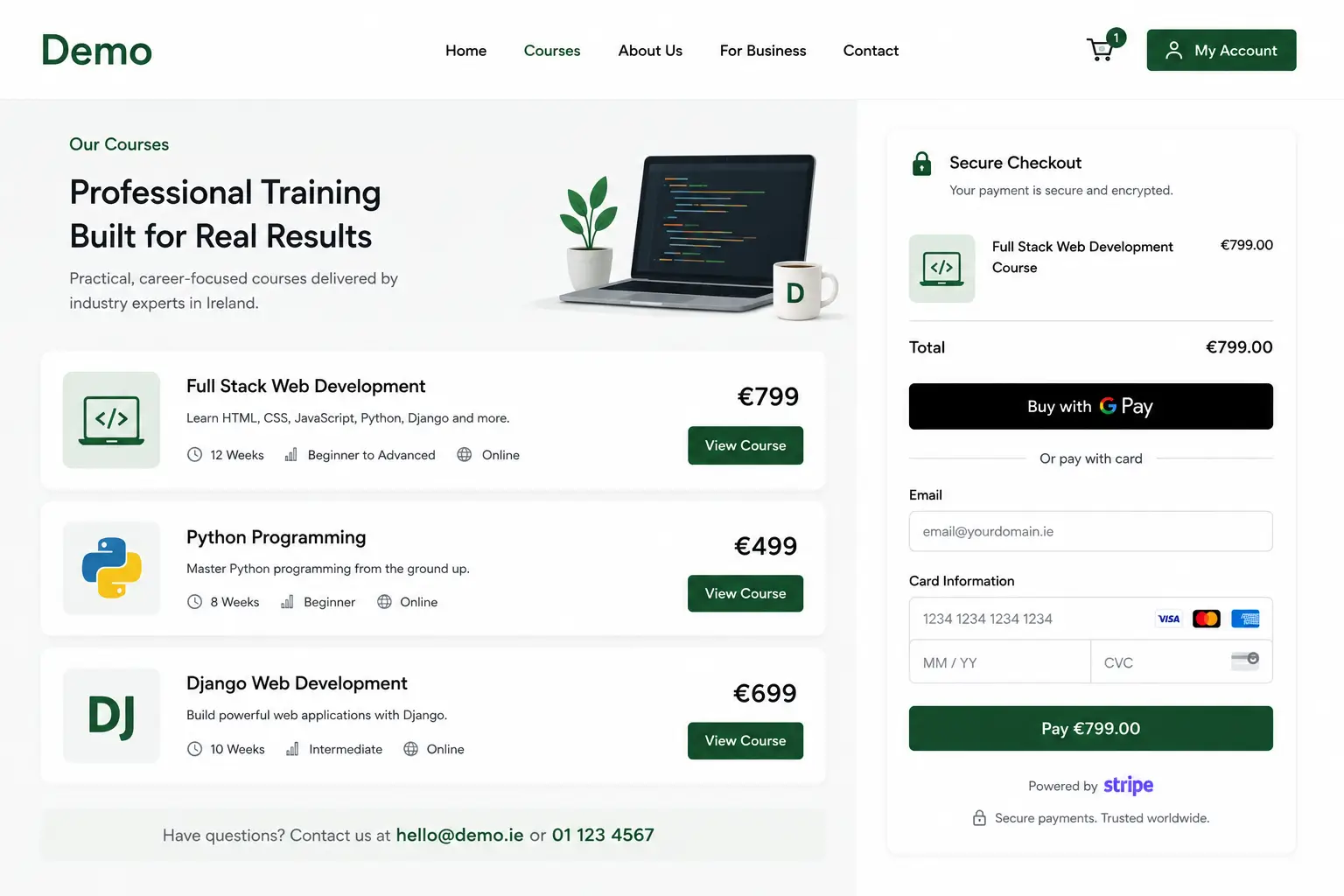
Trust matters here too. A buyer on Amazon trusts Amazon. On your site, they're trusting a business they may never have heard of, so returns information, real contact details and recognisable payment options do real work. We've written up what builds trust on a new Irish ecommerce store, because an untrusted store has a high cost per order no matter how good the traffic is.
Repeat customers are where your own site pulls ahead
A marketplace charges commission on every order, including the fourth order from a customer who'd now buy from you anyway. On your own site you pay to win that customer once. After that, a reorder costs you an email.
Run it on the same illustrative order: a customer who buys four times a year costs you €30.12 in Amazon fees, or €7.16 on Shopify. That's €22.96 a year more in your pocket from one loyal customer, and you also have their email address and permission to contact them. Amazon keeps buyers' contact details behind its own messaging system, and its rules stop you pointing those buyers to your own shop, so the relationship stays with Amazon however often they buy.
Your store has to be built to earn those reorders. When we built The School Shop's Shopify store, customer accounts with order history were part of the brief, because parents come back every school year.
Order value matters as well, since fixed fees like the €0.25 per card payment shrink as baskets grow. On Gadget Geek's rebuilt store, related products, collection upsells and complementary accessories on product pages lifted average order value by 35%. That's the approach in our guide to upselling and cross-selling for Irish stores.
When a marketplace is still the right call
We build online stores for a living, and we'd still tell some sellers to start on a marketplace. The higher fee buys things that are expensive to get any other way.
- You're testing a product. If you don't know yet whether anyone wants it, a listing on Etsy or eBay costs almost nothing up front. Prove the demand before you spend €2,500 on a store.
- Buyers search the marketplace for your category. For branded goods, replacement parts and commodity items, people go straight to Amazon. Fighting that with a new site is expensive. Handmade and vintage items on Etsy are similar.
- You have no time or budget for marketing. If you can't spend a few hours a week on content, email or social, your own site won't get the traffic, and the commission is the cheaper option.
- You need fulfilment. Fulfilment by Amazon stores, picks and ships for you. It costs extra per unit, but it can still beat renting space and packing orders yourself.
The Etsy vs own website choice deserves its own note: Etsy suits makers early on, but at our example rates it takes over 11% of the order, and more when Offsite Ads kick in. Once repeat buyers and Instagram followers are asking for your products by name, those are customers you're paying Etsy for. Our social media marketing work is often about sending that audience to a shop you own instead.
How to run both channels without undercutting yourself
For most Irish sellers the answer isn't one or the other. It's a marketplace for reach and your own site for margin, with a clear job for each.
- Work out your fee per order on each channel using your real order value and category, as in the first table. Do it per product, because a 15% category and a 7% category are different businesses.
- Price with the fees in mind. Many sellers charge a little more on the marketplace to cover commission. Check each marketplace's pricing rules before you do, because some penalise listings priced higher than elsewhere.
- Make your own site the place for the full range, bundles and reorders, so there's a reason to buy there.
- Fix the checkout before you spend on traffic. Paying to bring a buyer to your site and losing them at the payment step is the most expensive way to lose a sale. Our guide to reducing cart abandonment lists what to check.
- Follow each marketplace's rules on contacting buyers. Don't put flyers for your website in Amazon parcels. Grow your own list from the buyers who find you directly.
- Review the numbers every quarter. Fees change, and so does your cost per order on your own site as it gains traffic.
Already selling on a marketplace?
We can set up your own store alongside it, so your best customers and their reorders stop paying commission. Tell us what you sell and roughly how many orders you take a month.
When your own store pays for itself
The build is a one-off cost, so the fee gap between your own site and the marketplace tells you how long it takes to earn back. Our ecommerce website design starts at €2,500 for a standard Shopify or WooCommerce store. At the €5.74 per order you'd save against Amazon in our example, that's about 436 orders moved to your own site. At 50 orders a month, that's under nine months.
Two things can shorten it. If you qualify for the Trading Online Voucher from your Local Enterprise Office, it covers 50% of eligible costs (excluding VAT), up to €2,500, which halves that figure to about 218 orders. And reorders count towards it at almost no marketing cost.
Running costs are small but real. Shopify Basic is €32 a month on monthly billing or €24 a month billed yearly, and a WooCommerce store needs hosting, updates and someone watching it, which our website maintenance and support covers.
Deciding between your own website and a marketplace
The own website vs marketplace decision comes down to your own numbers, so put them into the first table: your real order value, your category's fee and your orders per month. If the gap per order is bigger than what you'd spend to win a customer yourself, or you have buyers who come back, start building your own store and keep the marketplace for reach. If you're still proving the product, stay where the buyers are for now, and read how to design an ecommerce website that converts so you're ready when you make the move.
If you'd like a second opinion on your own margin maths, we're happy to go through it with you. Get in touch with us for a no-obligation chat about whether your own store makes sense yet, and what it would cost.