Introduction
A sports club website in Ireland needs nine things to actually work for its members: up-to-date fixtures and results, a news section, online membership sign-up and renewal, volunteer and committee information, a visible sponsors page, a photo gallery, clear contact and location details, a training and event schedule, and a back end simple enough for a non-technical committee member to update without calling a developer. Miss any of these and the site becomes exactly what most club websites already are: a nice-looking thing nobody trusts because the fixtures are three months out of date.
If you sit on a GAA, soccer, rugby or cricket club committee, or you run a community or voluntary organisation, you already know the problem. Someone built the club a website two or three years ago, it looked great on launch day, and now it quietly rots while all the real information lives on WhatsApp and a Facebook page. This guide covers what an Irish club site genuinely needs, where the common mistakes happen, and how membership, sponsorship and GDPR actually fit together, based on real club work rather than a generic template checklist.
Why Most Club Websites Fail Within a Year
A business website can survive being ignored for a while. A club website cannot, because its entire value is timeliness. A member checking training times, a parent looking up an underage fixture, or a sponsor checking whether their logo is still up: all three lose trust the moment the information is stale. Once a committee member notices the site is out of date, they stop bothering to update it, and the decline becomes permanent within a season.
This is not a design problem. It is a maintenance and ownership problem, and it is the single biggest reason club websites in Ireland end up abandoned in favour of a Facebook page and a group chat. Anyone building or commissioning a club site needs to solve for this from day one, not bolt it on afterwards.
The Core Pages a Sports Club Website Needs
Every club site, whatever the sport, needs the same functional backbone. Fixtures and results have to sit in one predictable place, updated weekly during the season, not scattered across social posts that scroll out of view within days. A news and updates section gives the club somewhere to post AGM notices, club lotto results, or a new sponsor announcement without it disappearing the way a social post does. Membership sign-up and renewal needs to be a page a new member can find within two clicks of landing on the homepage, not something buried three menus deep.
Volunteer and committee information matters more than most clubs realise. Naming the chairperson, secretary, treasurer and coaching staff, with a way to contact each role, gives the club a human face and answers the question every prospective parent or player actually has: who do I talk to? A sponsors page belongs here too, not as an afterthought. So does a photo and media gallery that shows the club's actual character, clear contact and location details for the grounds or clubhouse, and a training and event schedule that covers the practical logistics members check most often: what time, which pitch, which age group.
None of this is exotic. What separates a club site that works from one that quietly dies is whether these sections stay current, and that comes down to who can edit them and how easily.
Getting Membership Sign-Up and Online Payment Right
For most Irish clubs, membership registration and renewal is the one feature worth building properly, because it directly replaces an annual headache of cash envelopes, spreadsheets and chasing people at training. A well-built membership page needs separate tiers for juvenile and adult members (and often family or student rates), a clear breakdown of what each tier includes, and online payment so renewal takes two minutes instead of a conversation at the clubhouse door.
Our guide to setting up online payment for a course or training website covers the underlying payment setup in detail, and the same principles apply directly to club membership: a secure checkout, automatic renewal reminders, and a record of who has paid that the treasurer can actually see. If your club also runs bookable sessions, taster days or coaching blocks, our piece on adding an online booking system to a website in Ireland is worth reading alongside this one, since many clubs eventually need both membership payment and event booking on the same site.
GDPR and juvenile member data
Clubs process personal data for members of all ages, including children, and that data needs to be handled carefully. As a matter of good general practice rather than specific legal advice, this means only collecting the information the club genuinely needs (name, age category, guardian contact, medical notes where relevant), storing it securely rather than in an open spreadsheet, being clear with parents about what data is held and why, and never publishing a juvenile member's full name and photo together without permission. The GAA's own data protection guidance for clubs is a useful reference point even for non-GAA clubs, since the underlying obligations under Irish and EU data protection law apply to any organisation processing member data, sporting or otherwise.
Does Your Club Need a Website Volunteers Can Actually Run?
We build websites for GAA, soccer, rugby and cricket clubs, and community organisations across Ireland. Custom-built from €1,500, live in weeks, and simple enough for your committee to update without a developer.
Why a Visible Sponsors Page Is Worth More Than Clubs Think
Most committees treat the sponsors section as a courtesy: a row of logos near the footer that gets updated once a year if someone remembers. That undersells it badly. A local business sponsoring a jersey or a pitch wants to know their name is actually seen, and a static logo wall buried at the bottom of a homepage does not show that. A dedicated sponsors page, with each sponsor's logo, a line about their business, and a link through to their own website, gives a sponsor something concrete to point to when they justify the spend to themselves next season.
This matters more than clubs realise at renewal time. A sponsor who can see their logo getting genuine visibility, alongside fixture updates and gallery photos that prove the club is active and well run, is far more likely to renew than one whose only proof of the sponsorship is a jersey nobody photographs. A club website with an obviously current, professionally presented sponsors section is one of the more direct ways a site pays for itself, and it is one of the most undervalued reasons to get the site right in the first place.
Built for Volunteers, Not for Developers
The single biggest determinant of whether a club website survives past its launch is whether the people running the club can update it themselves. Most Irish clubs are run entirely by volunteers with no web development background, and a site that requires a developer for every fixture change or news post is a site that will be six months out of date by the following season, however well it was designed on day one.
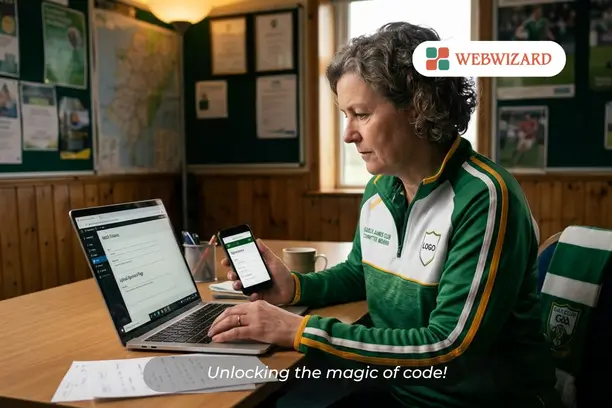
This is exactly the brief we worked to for Clondalkin Cricket Club, a fast-growing Dublin cricket club that came to us with training times, team information and event updates scattered across social posts and word of mouth, and no single place for a prospective member to understand what the club offered. We built the site on WordPress with a Bootstrap front end, and set up custom content sections so club volunteers can add or edit event details, team updates, news and gallery photos themselves, with no technical experience needed. That is the feature that matters most for a volunteer-run club: not the one visitors see, but the one that means the site stays current without depending on a developer for every fixture change, which is exactly where most club websites quietly die.
If your club is choosing a platform for the first time, our guide to what makes a website design genuinely user-friendly is worth reading from the committee's perspective, not just the visitor's. A club site has two audiences who both need it to be easy: the members reading it, and the volunteer updating it.
Choosing a Platform: GAA Systems, Website Builders or a Custom Build
GAA clubs specifically have an official option through the association's Foireann membership system and its preferred website partner, Club and County, which is built and maintained in collaboration with the GAA and integrates directly with national membership data. That is a sensible starting point for many GAA clubs and worth investigating first. Soccer, rugby, cricket and community organisations do not have an equivalent national platform, and even GAA clubs sometimes want more design and content flexibility than an off-the-shelf club system provides. The table below breaks down the realistic options.
| Option | Best for | Membership & payment | Volunteer editing | SEO and design control |
|---|---|---|---|---|
| GAA official system (Foireann / Club and County) | GAA clubs wanting national data integration | Built in, tied to GAA membership records | Straightforward within the GAA's own template | Limited: shared template, GAA branding constraints |
| General website builder (Wix, Squarespace) | Very small clubs on a tight budget | Basic, via third-party add-ons | Easy for simple edits, clunky for structured content | Limited: template-based, weaker on-page SEO control |
| Custom WordPress build | Any sport or community org wanting a real digital home | Fully custom: membership tiers, renewals, online payment | Purpose-built content sections, no developer needed | Full control: clean URLs, structured content, fast pages |
For any club outside the GAA's own ecosystem, or a GAA club that wants a site that looks and reads as genuinely theirs rather than a shared template, a custom WordPress build is usually the right call. It is also the approach we would recommend reviewing against a web design quote comparison before committing, since club budgets are tight and it pays to know what you are actually paying for.
Common Mistakes Club Websites Make in Ireland
Most club websites fail for the same handful of avoidable reasons. Here is where it usually goes wrong.
Fixtures and results left stale for months. This is the most common and most damaging mistake on any club site. A member who checks the fixtures page and finds last month's results assumes the whole site is unreliable, and stops checking it at all. Once that trust breaks, it rarely comes back, and the club is effectively back to relying on WhatsApp.
No mobile-friendly design. Most club traffic arrives from a phone, often from someone standing at the pitch trying to confirm a training time. A site that is not properly responsive, with small tap targets or text that requires zooming, loses exactly the members who need it most urgently. Our website navigation and menu structure guide covers how to keep the essentials, fixtures, contact and how to join, within easy reach on a small screen.
Contact and "how to join" information buried. Plenty of club sites look polished but hide the one thing a prospective member actually wants: how do I sign up, and who do I talk to? If that information is three clicks deep in a submenu, most visitors give up before finding it.
No clear sponsor visibility. As covered above, a sponsors section that nobody can find, or that has not been updated in years, wastes one of the site's most tangible commercial benefits. Sponsors renew when they can see the value. They do not renew when they cannot find their own logo.
A site technically impressive but nobody on the committee can maintain. The most expensive mistake a club can make is commissioning something too complicated for its own volunteers to run. A beautifully designed site that requires a developer for every update becomes a beautifully designed site from eighteen months ago. This is closely linked to ongoing technical upkeep too. Our post on what happens when you don't update WordPress plugins explains why an unmaintained site is also a security risk, not just an outdated one, and why club sites in particular tend to get neglected on this front.
SEO Basics That Help a Local Club Get Found
A club website does not need advanced SEO, but it does need the basics done properly, and Google's own guidance is genuinely useful here rather than mysterious. Google's SEO starter guide recommends descriptive, meaningful URLs over random identifiers, and logically organised pages so both users and search engines understand how your content relates. For a club, that means a URL structure like webwizard.ie/blog rather than a jumble of numbers, and grouping fixtures, membership and news as clearly labelled sections rather than one long homepage. Our practical guide to website structure for SEO in Ireland goes into this in more depth if you want the full picture.
Beyond the site itself, a claimed and up-to-date Google Business Profile matters for any club with a physical clubhouse or grounds it has the authority to represent, since that is Google's actual eligibility bar for local listings, covered well in our guide to mastering Google Business Profile. Location-based content helps too: naming the town, county and specific grounds throughout the site, rather than only in the contact page, is what lets a search for "GAA club [town]" or "soccer club near [area]" actually surface your site instead of a generic directory listing.
Ready to Give Your Club a Website It Can Actually Keep Current?
Tell us about your club or community group and we'll propose the simplest site that gets you more members, more sponsor value and more engagement, with a clear written quote first.
Choosing the Right Platform and Domain for Your Club
Two practical decisions sit underneath everything above: the platform, and the domain. For most clubs and community organisations, a WordPress build gives the best balance of low ongoing cost, volunteer-editable content, and full SEO control, which is why our WordPress website design service is the platform we recommend for club sites by default. If your club also plans to sell merchandise, run a lotto page, or eventually needs something more bespoke than a standard membership setup, our custom web application development service covers that ground.
The domain matters more than clubs tend to think too. A club owning its own dedicated domain, rather than relying only on a Facebook page or a shared county association subdomain, is both a credibility signal and something the club actually controls long-term. Our guide to choosing and buying a domain name in Ireland covers exactly how to get this right from the start, so the club is not stuck renting its own name from a third party.
Whatever platform a club chooses, ongoing upkeep is not optional. Fixtures need weekly attention during the season, plugins and security updates need regular checking, and someone on the committee needs to own that responsibility, ideally with a backup. If your club would rather hand that off, our website maintenance and support service exists specifically for organisations that want the site kept current and secure without relying on one volunteer's spare time. And if the club is a registered business or charity rather than a sports club specifically, the same logic applies through our wider business website design service.
Frequently Asked Questions
What does a sports club website need in Ireland?
How much does a GAA or sports club website cost in Ireland?
Can club volunteers update the website themselves without a developer?
Do sports clubs need to worry about GDPR when collecting member data online?
Getting a club or community website right is less about design polish and more about whether the people running the club can actually keep it alive season after season. If your club is weighing up an official association platform, a website builder, or a proper custom build, we would be glad to talk through what fits your budget and your committee's technical comfort level. Get in touch with Web Wizard for a no-obligation conversation about what your club actually needs.