Introduction
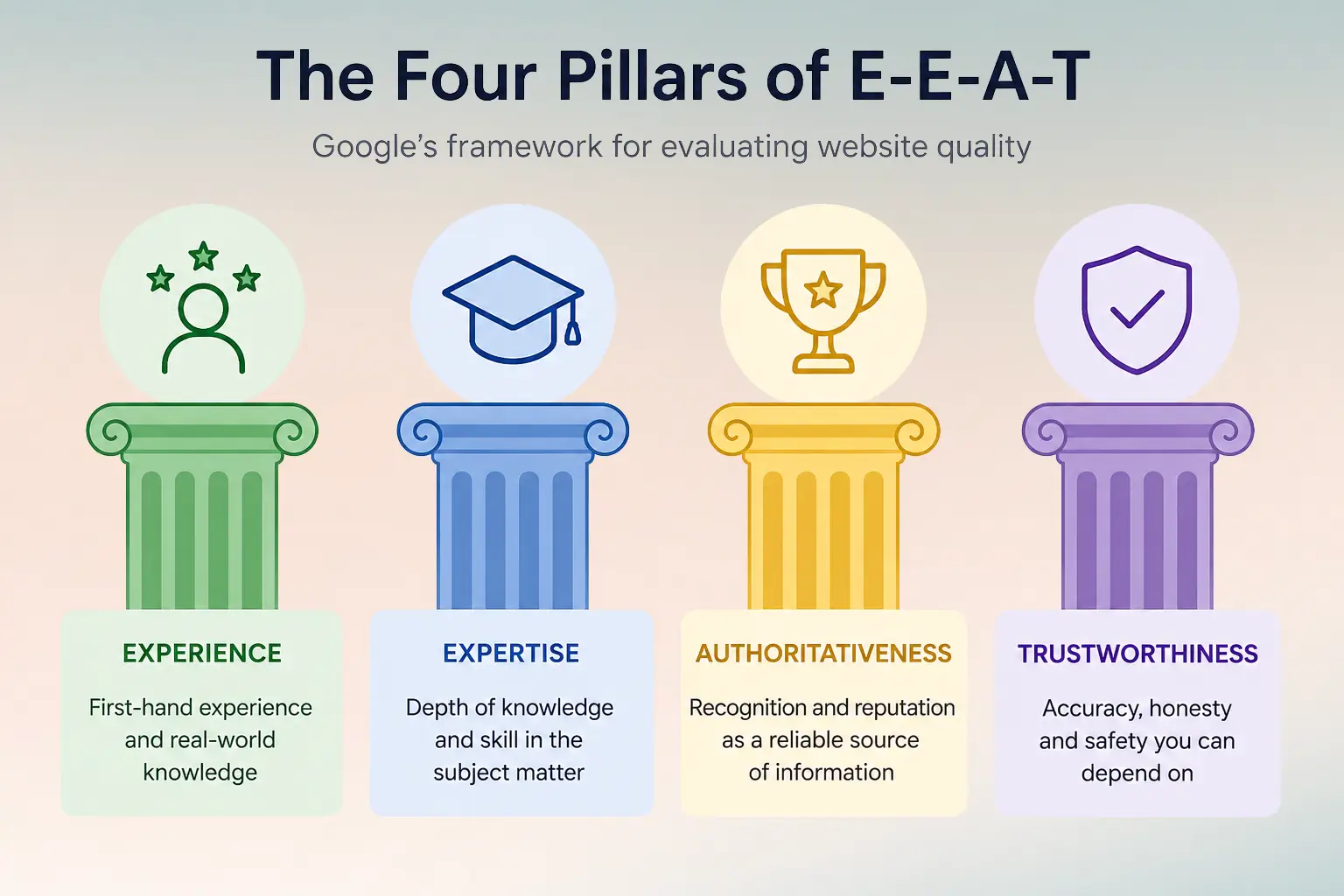
You have probably heard the term E-E-A-T thrown around in SEO reports without anyone actually explaining what it means for your business. Maybe your developer mentioned it. Maybe you read it in a forum post about why a competitor outranks you despite having a worse-looking website. What is E-E-A-T, in plain terms? It stands for Experience, Expertise, Authoritativeness, and Trustworthiness, and it is the framework Google's human quality raters use to judge whether a page deserves to rank. It is not a single algorithm switch you can flip. It is a collection of signals built up over months through how your site is structured, who writes your content, and how consistently you cover your subject.
This matters more in 2026 than it ever has. AI Overviews now sit at the top of a huge share of Google searches, pushing traditional organic results further down the page, which means the sites that do get clicked are increasingly the ones Google's systems trust the most. For an Irish accountant, a Dublin physiotherapist, or a Cork builder competing for local search visibility, understanding E-E-A-T is no longer optional reading. It is the difference between a website that grows traffic year on year and one that plateaus no matter how many blog posts get published.
This guide goes further than most explanations of E-E-A-T. Most articles describe the four components in isolation and stop there. We are going to connect E-E-A-T to three technical SEO mechanics that quietly undermine it on most websites: keyword cannibalization, wasted crawl budget, and weak topical authority. If you run a website with overlapping pages, thin content, or inconsistent coverage of your subject, this is likely the real reason your trust signals are not being recognised, even if your content itself is good.
What Is E-E-A-T and How Does Google Actually Use It
E-E-A-T stands for Experience, Expertise, Authoritativeness, and Trustworthiness. It is a framework set out in Google's Search Quality Rater Guidelines and used by thousands of human raters to assess the quality of search results, particularly for topics that affect a person's health, finances, or safety. It is not a direct ranking factor that gets calculated and applied to your page like a score. Instead, Google's algorithms are trained on rater feedback to recognise the patterns associated with high and low E-E-A-T content, and those patterns then influence rankings at scale.
Experience: Has the Author Actually Done This?
Experience was added to the framework in December 2022, when Google updated its Search Quality Rater Guidelines to recognise that firsthand involvement with a subject matters separately from textbook knowledge of it. A blog post about setting up a WooCommerce store written by someone who has actually configured payment gateways, shipping zones, and tax rules for Irish customers reads differently to one written by someone who has only read about WooCommerce. Google's raters are trained to spot the difference, and so, increasingly, are its systems. Personal anecdotes, specific numbers, screenshots of real dashboards, and references to actual problems encountered are the signals that demonstrate experience.
Expertise: Does the Author Know the Subject Properly?
Expertise is about depth of knowledge rather than firsthand experience. A solicitor writing about probate law in Ireland demonstrates expertise through accurate, specific, legally correct content, not through having personally gone through probate themselves. For most business topics, expertise is shown through correct terminology, an understanding of nuance, and the ability to explain exceptions and edge cases rather than only the headline rule. On a website, this is usually reinforced through author bios, qualifications, and content that goes beyond surface-level generalisation.
Authoritativeness: Does the Wider Web Agree You Are a Credible Source?
Authoritativeness is reputation that exists outside your own claims about yourself. It is built when other credible sites link to you, when industry publications reference your work, when people search for your brand name directly, and when your content gets cited or shared by others in your field. You cannot simply declare yourself authoritative in your own copy. Authority is something the rest of the internet has to confirm through links, mentions, and citations, which is why backlink quality and digital PR remain relevant even in an AI-driven search landscape.
Trustworthiness: The Most Important of the Four
Google's own guidelines state plainly that trust is the most important member of the E-E-A-T family, because without it, experience, expertise, and authority carry little weight. Trustworthiness covers accuracy, transparency, secure browsing (HTTPS), clear contact details, genuine customer reviews, honest pricing information, and the absence of misleading claims. A beautifully designed site with vague ownership and no verifiable contact information will struggle to rank well for anything competitive, regardless of how polished the writing is.
Featured snippet answer: E-E-A-T stands for Experience, Expertise, Authoritativeness, and Trustworthiness. It is the framework Google's human quality raters use, as defined in the Search Quality Rater Guidelines, to judge whether content demonstrates firsthand experience, genuine knowledge, external recognition, and honesty. Google's ranking systems are trained on this rater feedback rather than applying E-E-A-T as a direct scoring formula.
How Keyword Cannibalization, Crawl Budget, and Topical Authority Quietly Destroy E-E-A-T
This is the section most explanations of E-E-A-T skip entirely, and it is the one that actually explains why a site with genuinely good content still underperforms. The four E-E-A-T components do not exist in a vacuum. They depend entirely on Google being able to find your content, understand which page is the authoritative one on a subject, and revisit your trust signals often enough to keep its assessment current. Three technical issues consistently break that process: keyword cannibalization, wasted crawl budget, and weak topical authority. Understanding how these three interact is, frankly, more useful than memorising the four E-E-A-T letters.
Keyword Cannibalization Fragments Your Authority Signals
Keyword cannibalization happens when two or more pages on the same website target the same or very similar keyword, so they compete against each other in Google's index instead of one page winning the position clearly. We see this constantly in Irish business sites: a "web design Dublin" service page, a blog post about "web design Dublin costs", and a location page all targeting near-identical phrasing. Instead of one authoritative page accumulating backlinks, internal links, click data, and topical depth, those signals get split three ways. Google has to guess which page is the real expert source, and a confused algorithm tends to rank none of the competing pages particularly well.
The E-E-A-T consequence is direct. Authoritativeness is built through accumulated external signals such as backlinks and citations pointing at a specific URL. When those signals are split across multiple competing pages, no single page ever reaches the critical mass needed to look authoritative to Google. You might have excellent total content on a subject across your site, yet appear weak on that subject because your authority is diluted rather than consolidated.
Wasted Crawl Budget Slows Down Trust Signal Re-Evaluation
Crawl budget is the finite amount of attention Googlebot allocates to crawling your site within a given period, based on factors like your site's size, server speed, and how valuable your pages have historically proven to be. It is not infinite, even for established sites, and for smaller business websites with limited authority, it is often tighter than people assume. Google's own Search Central documentation on crawl budget confirms that Googlebot prioritises pages it judges worth the cost of crawling.
Here is where it connects back to E-E-A-T directly. If a meaningful share of your crawl budget is consumed by thin pages, duplicate near-identical content from cannibalization, or low-value auto-generated pages, Googlebot has less capacity left to revisit the pages that actually carry your trust signals: your About page, your author bios, your reviews page, and any content you have recently updated. Trustworthiness and experience are not static assessments. Google needs to re-crawl and re-evaluate them periodically to keep its understanding of your site current. A site that wastes crawl budget on clutter is, in effect, asking Google to re-check its most important credibility pages less often than it should, which slows down how quickly genuine improvements to your E-E-A-T actually register in rankings.
Topical Authority Is Where All Three Problems Converge
Topical authority is the degree to which Google recognises your site as a comprehensive, consistent, reliable source on a specific subject area, built through depth of coverage, internal linking between related content, and consistency over time rather than a single excellent article. A site with one brilliant article and forty thin, unrelated ones has weak topical authority. A site with twenty solidly researched, well-linked articles covering every angle of one subject has strong topical authority, even if no single article is spectacular.
This is where the causal chain becomes clear. Keyword cannibalization fragments topical authority by splitting the signals for a single subject across multiple competing pages instead of consolidating them into one deep, authoritative resource. Wasted crawl budget on those same thin or duplicate pages then means Google revisits your genuine trust and freshness signals less frequently, slowing the rate at which improvements to authorship, reviews, and updated content are recognised. The combined effect is that even a site with genuinely knowledgeable content ends up looking scattered and slow to update in Google's eyes, which directly undermines the Expertise and Trustworthiness components of E-E-A-T. Fix the cannibalization, consolidate the authority, and free up the crawl budget, and you remove the structural barriers stopping Google from recognising the expertise that was already there.
Worried Your Site Structure Is Hurting Your Rankings?
Custom Web Design Starting at €1,500 | No Hidden Fees | Free Consultation | Custom, SEO-ready site in 4 weeks (not 12-16)
How E-E-A-T Differs Across Industries and Why YMYL Pages Face Stricter Scrutiny
Not every website is judged with the same intensity. Google applies a category called YMYL, short for "Your Money or Your Life", to pages whose content could affect a person's health, financial stability, safety, or major life decisions. If you run a healthcare website, a financial advisory practice, or a solicitor's practice, your content is held to a noticeably higher trust bar than a portfolio site for a graphic designer.
For a GP or family practice website, that means clear medical credentials, GMC or IMC registration details, and content reviewed by qualified staff rather than generic health advice copied from elsewhere. For a chartered accountant's website, it means accurate, current tax information and named, qualified professionals rather than an anonymous "our team" page. We have seen dental clinics and physiotherapy practices lose ranking visibility purely because their About page listed no names, no qualifications, and no registration numbers, even though the clinical care itself was excellent.
Non-YMYL sites, such as a builder's website or a personal portfolio site, still benefit from E-E-A-T improvements, but the bar for ranking is generally lower. That does not mean trust signals are irrelevant for a local electrician or plumber. Genuine customer reviews, a verified Google Business Profile, and a clear "about the owner" section still meaningfully influence local search visibility, just with less algorithmic scrutiny than a medical or financial page would receive.
| Industry Type | YMYL Scrutiny Level | Key Trust Signals Required |
|---|---|---|
| Healthcare & medical | Very high | Named clinicians, registration numbers, clinically reviewed content |
| Financial & legal services | Very high | Qualifications, regulatory registration, accurate up-to-date guidance |
| Education & training | Moderate | Tutor credentials, accreditation details, transparent course outcomes |
| Trades & construction | Low to moderate | Genuine reviews, licensing details, verified contact information |
| Personal & portfolio sites | Low | Author identity, real work samples, consistent online presence |
Practical Steps to Improve E-E-A-T Without Rebuilding Your Whole Website
Improving E-E-A-T does not require starting from scratch. Most sites can make meaningful progress within a few weeks of focused work, and the order in which you tackle issues matters.
Start with an honest content audit. Pull a list of every URL on your site indexed in Google Search Console and look for pages targeting the same or near-identical keywords. This is where cannibalization tends to hide in plain sight, often between an old blog post and a newer service page covering similar ground. Consolidate where you find overlap: pick the stronger page, redirect or merge the weaker one, and update internal links to point to the single authoritative version.
Next, check your crawl efficiency. If your site has hundreds of thin tag pages, outdated blog posts with no traffic, or duplicate product variations, that is crawl budget being spent on the wrong things. Noindexing or removing low-value pages frees up Googlebot's attention for the pages that actually carry your authorship, reviews, and freshness signals.
Then address authorship directly. Every meaningful piece of content should have a named author with a real bio, ideally linking to a LinkedIn profile or professional credential. If your About Us page is generic stock text, rewrite it with actual names, actual experience, and an actual photo. This single change moves the needle on Expertise and Trustworthiness more than most people expect. Content freshness matters here too, and our guide on how often you should update your website content sets out a realistic schedule rather than a vague "keep it fresh" rule.
Finally, build topical depth deliberately rather than publishing whatever comes to mind. Map out the five or six core subjects most relevant to your business and commit to covering each one properly with internally linked content, rather than scattering one-off posts across unrelated topics. This is the same principle that underpins good SEO services work generally: depth and consistency beat volume.
Common Mistakes Businesses Make When Trying to Improve E-E-A-T
Adding a Generic "Meet the Team" Page and Calling It Done
A team page with first names only and no qualifications, photos, or specifics does very little for Expertise or Trustworthiness. Google's raters are specifically trained to look for verifiable detail, not just the presence of a team page. If your bios could apply to literally anyone, they are not doing the job.
Buying Backlinks Instead of Earning Authority
Paid link schemes from irrelevant directories or link farms are one of the fastest ways to damage Authoritativeness rather than build it. Google's systems are increasingly good at identifying unnatural link patterns, and the penalty risk far outweighs any short-term ranking bump. Genuine digital PR, partnerships, and referral relationships build the same signal far more durably.
Ignoring Crawl Efficiency Because "Google Will Find It Eventually"
Eventually is the problem. If your most important trust-building pages take months to get re-crawled because Googlebot is busy with thousands of thin or duplicate URLs, your visible E-E-A-T lags behind your actual improvements. Submitting a clean XML sitemap and pruning low-value pages is not optional housekeeping, it is part of how trust signals get recognised on schedule.
Publishing Content With No Clear Subject Focus
Scattering one article about ecommerce, one about local SEO, and one about web accessibility, with no internal links tying them together, signals breadth without depth. Topical authority rewards sites that go deep on a manageable number of subjects rather than shallow on everything. This is also why a strong site structure for SEO matters as much as the writing itself.
Treating a Website Redesign as Purely Visual
Businesses frequently redesign a site for aesthetic reasons and accidentally flatten the URL structure, losing years of accumulated authority signals on key pages in the process. Any website redesign should map old URLs to new ones with proper redirects and preserve the pages that already carry trust and ranking equity, which is exactly the kind of planning covered in our website redesign strategy and planning guide.
Get an Honest Review of Your Site's Trust Signals
Custom Web Design Starting at €1,500 | No Hidden Fees | Free Consultation | Custom, SEO-ready site in 4 weeks (not 12-16)
Where E-E-A-T Fits Inside Your Wider SEO and Website Strategy
E-E-A-T does not operate separately from the rest of your SEO work. It sits on top of the technical and structural foundations you already need to get right. A site built on WordPress with clean code and fast load times gives Google fewer reasons to deprioritise your crawl budget on technical issues. A properly planned website design project that avoids duplicate category pages prevents cannibalization before it starts. Regular website maintenance keeps content fresh, which is itself a trust signal Google's systems weigh when judging how current your expertise is.
If you compare on-page SEO and off-page SEO, E-E-A-T draws on both. On-page work, like clear authorship, accurate content, and logical site structure, builds Expertise and Trustworthiness directly. Off-page work, like genuine backlinks, mentions, and reviews, builds Authoritativeness. Neither works particularly well in isolation, and our piece on whether off-page SEO is still effective covers this balance in more depth.
For ecommerce businesses, E-E-A-T shows up in product description quality, return policy transparency, and genuine customer reviews, all of which connect to our guide on writing product descriptions that rank and convert. A Shopify store with thin, duplicated product pages across colour variants is a textbook crawl budget and cannibalization problem rolled into one.
None of this needs to be overwhelming. Most businesses can meaningfully improve their E-E-A-T position within a single quarter by fixing the structural issues first: consolidate competing pages, prune the clutter eating your crawl budget, and put real names and real credentials on your content. The algorithmic complexity Google runs behind the scenes does not need to be your problem. Getting the fundamentals right consistently is what actually moves rankings, and that holds true whether you run a gym website in Mullingar or a tutoring business in Athlone.
What This Means for Your Website Going Into Next Year's Algorithm Updates
E-E-A-T is not a checklist you complete once. It is an ongoing reflection of how well your site demonstrates real experience, genuine expertise, external recognition, and honest practice. The mechanics behind it, though, are entirely fixable: stop competing against yourself with cannibalized keywords, stop wasting crawl budget on pages nobody needs, and build topical authority deliberately rather than by accident. Get those three things right and the four E-E-A-T components you have been reading about for years start showing up where Google can actually recognise them.
If you want a clear-eyed look at where your own site stands, get in touch with Web Wizard for a no-obligation conversation. We will look at your site structure, your existing content, and your trust signals, and tell you honestly what is holding your rankings back and what is worth fixing first.