Introduction
Google determines SEO rankings with automated systems that first work out what a search means, then compare every indexed page that could answer it on relevance, quality, usability and the searcher's own context, such as location and device. Nobody can pay for a higher position, and there is no secret list of 200 factors to tick off.
If you run a business in Ireland and your site sits on page three, you have probably been told a dozen different reasons why. Most of them come from SEO blogs repeating each other. This guide sticks to what Google itself has published about how rankings work, points out the popular claims Google has contradicted, and finishes with the order we would fix things in on a real small business site. It is the same order we follow in our SEO service for Irish businesses, so you can do the early steps yourself and decide later whether you need help.
How Google determines SEO rankings in three stages
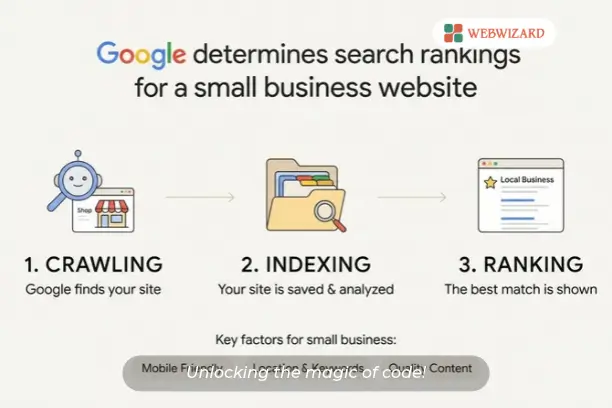
Google's own documentation on how Search works splits the process into three stages, and states plainly that not every page makes it through all three. Most ranking problems we see on small business sites are actually a failure at stage one or two, long before quality comes into it.
Crawling: Google has to find the page
Googlebot discovers pages by following links and reading sitemaps. A page that nothing links to, or that is blocked in robots.txt, may never be fetched at all. This is why a clear menu and sensible internal links matter more than most people think, and why we covered planning them in our guide to website structure for SEO.
Indexing: Google has to understand and store it
Once fetched, Google analyses the text, images and video, decides whether the page is a duplicate of another one, and chooses which version to keep. A page with a noindex tag, a login wall or thin, near-identical copy can be crawled and still left out of the index. Structured data can help Google read facts like your opening hours or prices correctly, which we explain in what schema markup does for search, but it is not a ranking boost in itself.
Serving: Google picks and orders the results
Only now does ranking happen. When someone searches, Google pulls the indexed pages that could answer the query and orders them. Its documentation says relevance is decided by "hundreds of factors", including the searcher's location, language and device, and that Google "doesn't accept payment to rank pages higher". The same search for a plumber gives different results in Mullingar and in Dublin 8, and that is by design.
The five factors Google says it weighs
Google's public explainer on how it ranks results groups everything into five areas. This is the closest thing to an official list of Google SEO ranking factors, and it is far more useful than the long lists on agency blogs because each area tells you what to work on.
1. The meaning of the query
Google first tries to establish the intent behind the words: whether the person wants to buy, compare, learn or find somewhere nearby. A page written for the wrong intent struggles however good it is. A service page will not rank for "how to fix a leaking tap", and a DIY guide will not rank for "emergency plumber Athlone".
2. Relevance of the content
Google says the most basic relevance signal is a page containing the same words as the search. It then goes beyond that, and it confirms it uses "aggregated and anonymised interaction data" to check whether results are relevant. That is all it says. The specific metrics you read about elsewhere, such as dwell time or scroll depth, are guesses, not confirmed signals.
3. Quality of the content
Here Google looks for signals of expertise, authoritativeness and trustworthiness, and one it names directly: whether other prominent websites link to or refer to the content. Google is also clear that E-E-A-T is not a single ranking factor you can score, it is a description of what its signals try to identify, which we unpack in what E-E-A-T is and why Google uses it. Links still count, which is why off-page SEO is still worth doing when it is done honestly.
4. Usability of the page
Google names page experience, specifically "mobile-friendly content that loads quickly". Google also indexes the mobile version of your site first, so a site that only works properly on a desktop is losing on this point before anyone reads a word. Our posts on mobile-first design and speeding up a WordPress site cover the fixes.
5. Context and settings
Location, past search history and search settings all shape what one person sees. This is why checking your own ranking by searching from your office is unreliable, and why two customers can see different results for the same phrase.
Not sure which of these is holding your site back?
We check crawling, indexing, content and page experience against what Google actually documents, then tell you what to fix first and what to ignore.
Google's named ranking systems, and which ones affect you
Behind those five areas sit specific systems. Google publishes a guide to its ranking systems that names them and says what each one does. It also notes that the systems work at the page level: Google ranks individual pages, not whole websites. Here are the ones that matter most to a small business site.
| System | What Google says it does | What it means for your site |
|---|---|---|
| BERT, RankBrain, neural matching | Understand how words relate to concepts and intent | Write the way customers talk. Repeating an exact phrase buys you nothing |
| Passage ranking | Finds the relevant section within a longer page | A clear answer under a clear heading can rank even inside a long guide |
| Link analysis and PageRank | Uses links between pages to understand what they are about | Genuine mentions from local press, suppliers and associations still help |
| Freshness systems | Show newer content where recency matters | Matters for prices, rules and news. Not for timeless topics |
| Deduplication and site diversity | Hide near-duplicates; generally no more than two listings from one site in top results | Twenty near-identical town pages will not give you twenty rankings |
| Exact match domain system | Stops keyword domains getting extra credit for the name alone | A domain like best-plumber-dublin.ie is not a shortcut |
| Original content systems | Show original reporting ahead of pages that only cite it | Your own photos, prices and project details beat rewritten copy |
| Spam detection (SpamBrain) | Deals with content and behaviour that break spam policies | Bought links and mass-produced pages get demoted or removed |
Two retirements are worth knowing about because you will still see them quoted. The helpful content system was folded into Google's core ranking systems in March 2024, so "helpfulness" is now judged everywhere rather than by a separate update. Panda and Penguin were absorbed years earlier. If an article in 2026 tells you to "recover from a Penguin penalty", it is out of date. Freshness is also widely misunderstood, and our post on how often to update website content explains when a refresh actually helps.
On AI search: Google's May 2026 guidance says its AI Overviews and AI Mode are "rooted in our core Search ranking and quality systems", so the same work applies. We looked at what that means in practice in AI content and SEO for Irish businesses.
Local rankings follow a different set of rules
If you serve customers in a particular town or county, much of your Google traffic will come from the map pack rather than the ordinary results. Google explains that local ranking comes down to three things. Relevance is how well your Business Profile matches the search. Distance is how far you are from the person searching, or from the place they named. Prominence is how well known the business is, which Google says draws on links, articles and directories across the web as well as your review count and score, and it adds that "more reviews and positive ratings can help".
Distance is the one you cannot change, which is why a Kinnegad business will rarely top a map search made in Dublin city centre. What you can control is a complete, accurate profile and a steady flow of real reviews. Google also states there is no way to request or pay for a better local ranking. Our guide to ranking a Google Business Profile walks through the setup, and trades in particular benefit from pages that match the jobs they do, which is how we approach websites for construction and trade businesses.
Ranking myths Google has publicly contradicted
This is where most ranking advice goes wrong. Each of the claims below appears on page one for "google seo ranking" right now, and each one is contradicted by Google's own documentation.
"Google uses over 200 ranking factors." Google has never published a list of 200 factors. Its documentation says "hundreds of factors" and moves on. Treating an unsourced number as a checklist is how people end up tweaking things that make no difference.
"Longer content ranks better." The SEO starter guide says the length of content alone does not matter and there is "no magical word count target". Its helpful content guidance lists writing to a word count as a warning sign.
"Meta keywords and keyword domains help." Google does not use the meta keywords tag at all, and says keywords in a domain name have hardly any effect beyond appearing in breadcrumbs.
"A green Core Web Vitals score means you'll rank." Google says Core Web Vitals are used by its ranking systems, but good scores do not guarantee top rankings, and it "always seeks to show the most relevant content, even if the page experience is sub-par". Speed is a tie-breaker between relevant pages, not a replacement for relevance.
"You need a separate strategy for AI search." Google says you do not need llms.txt files, special markup or content chopped into small chunks to appear in AI features. We covered the real traffic effect separately in what AI Overviews mean for Irish sites.
Our honest view: most of the energy small businesses spend on SEO goes on these myths, while the basics that Google does document go unchecked.
What to fix first to improve your Google ranking
Here is the order we work in on a small business site. The early steps cost nothing and solve more ranking problems than anything further down the list.
- Confirm Google can index your key pages. Use the URL Inspection tool in Search Console on your homepage and main service pages. If a page is not indexed, nothing else on this list matters yet.
- Give each service its own page. One page per service, aimed at one search intent, with a title that says what it is and where you work. A single "Services" page listing eight things rarely ranks for any of them.
- Write what only you can write. Real prices or price ranges, photos of your own work, the areas you cover, how the job actually runs. This is what Google's quality and original content systems are looking for.
- Fix the page experience basics. The site must work on a phone, load quickly and run on HTTPS. If the padlock is missing in the browser bar, fix that first.
- Complete your Google Business Profile and ask every happy customer for a review. Make sure your name, address and phone number match your website exactly.
- Earn real links and mentions. Local associations, suppliers, sponsorships and press coverage. Never buy them.
- Protect what you have when you change things. A redesign or platform move is the most common way we see small sites lose rankings overnight. Read how to redesign without losing SEO rankings before you start, and keep the site updated afterwards, which is what our website maintenance and support covers.
What this looks like on real projects
When we started on Gadget Geek's Shopify store, the SEO had been largely untouched: product titles and meta descriptions were missing or duplicated across categories, and there was no long-tail keyword strategy, so the store was invisible for the specific product searches that signal buying intent. We wrote unique titles and descriptions, restructured the store and cut page load time from 3.2 seconds to 1.1 seconds. The case study credits the 400% revenue growth to the combined effect of that work, not to SEO alone, and that is the honest way to read any ranking improvement.
For Setanta Safety in Waterford, our research showed national training organisations held the broad search terms, while local, course-specific searches such as "Safe Pass Waterford" were underserved. So we built one course page per search term on a clean technical base: clean URLs, an XML sitemap, crawlable robots.txt, canonical tags and local business schema. That is the first four steps above, applied to a real local business.
Is an older site the real reason you're not ranking?
If your site is slow on phones or crams every service onto one page, we can rebuild it around how Google ranks pages, with every old URL redirected properly. Websites from €1,500.
Common Google ranking mistakes we see
Chasing a tool's score instead of Google's data
Third-party SEO tools have no access to Google's ranking systems. A score going from 72 to 94 tells you the tool is happier, not that Google is. Judge changes on Search Console clicks and enquiries.
Changing the date to look fresh
Google's helpful content guidance names this directly: changing a page's date when the content has not substantially changed is a sign of search-first content. Update the content, then the date.
Building near-identical town pages
Swapping the town name on the same text is doorway abuse under Google's spam policies, and the site diversity system limits how many of your pages appear anyway. One strong page per genuine location or service works better.
Buying links or "SEO packages" with guaranteed positions
Paying for links is link spam under Google's spam policies, and sites that break them "may rank lower in results or not appear in results at all". Nobody can guarantee a position, because Google does not sell them.
Panicking after a core update
Google runs broad core updates several times a year and says a drop does not necessarily mean anything is wrong: other pages may simply have been judged more useful. A slide from position 2 to 4 needs no action. A fall from 4 to 29 is worth an honest review, followed by real improvements rather than quick fixes.
How to check where Google is ranking you
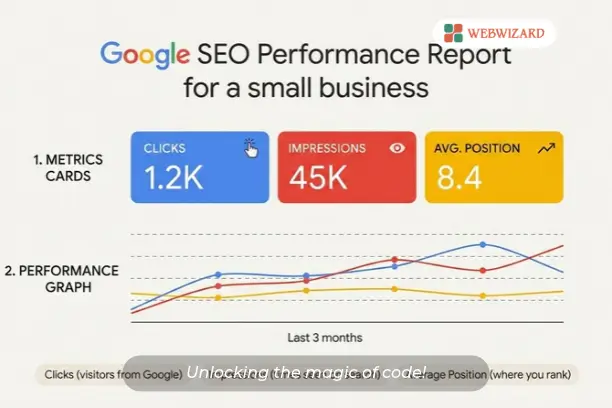
Google Search Console is the only source of real Google ranking data, and it is free. The Performance report shows every search your pages appeared for, how often, your average position and how many people clicked. Our round-up of free SEO tools for auditing your site covers setting it up alongside PageSpeed Insights.
The numbers can be humbling, and this page is a good example. The previous version of this article appeared in Google 2,539 times over three months at an average position of 30, and earned no clicks. Google clearly judged it relevant to "google seo ranking", it just was not good enough to reach page one. That pattern, lots of impressions at positions 11 to 40 with few clicks, is the clearest signal that a page is worth improving rather than replacing, and it is why we rewrote this one.
Frequently Asked Questions
How does Google determine SEO rankings?
Google crawls and indexes pages, then ranks the ones that could answer a search using automated systems. Its documentation groups the factors into five areas: the meaning of the query, relevance of the content, quality of the content, usability of the page and the searcher's context, such as location and device. If you want help applying this to your site, our SEO optimisation service starts with exactly that check.
Does Google really use over 200 ranking factors?
Google has never published a list of 200 factors. Its own pages say relevance is decided by "hundreds of factors" and name the main areas and systems, but not a checklist. Any article claiming to list all 200 is guessing. Working on the five areas Google does document is a far better use of your time.
Can I pay Google to rank higher?
No. Google states that it does not accept payment to rank pages higher in the organic results, and that there is no way to pay for a better local ranking. Google Ads appear in labelled ad slots, which are separate from the organic rankings. Anyone promising a guaranteed organic position is selling something Google does not offer.
How long does it take to rank on Google?
Google's starter guide says some changes take effect in a few hours and others take several months. A new site in a competitive Dublin market will take longer than an established site targeting a local niche. Building on a sound site from day one shortens the wait, which is why SEO is part of every website we design rather than an afterthought.
Why does my website rank on page 3 when a competitor ranks higher?
Usually because their page matches the search intent more closely, offers more specific information, is easier to use on a phone or has earned more genuine links and reviews. Check your own page is indexed, then compare it honestly with theirs on those points. Our guide to web design mistakes Irish businesses make covers the most common gaps we find.
Where to start with your Google ranking this week
Google determines SEO rankings on relevance first, then quality and usability, with the searcher's location shaping everything for local businesses. So start where Google starts: check your key pages are indexed in Search Console, give each service its own clear page, and make sure your Business Profile and website say the same thing. That alone fixes more rankings than any list of 200 factors.
If you would rather have someone go through it with you, we are happy to look at your site and tell you honestly what is holding it back. Get in touch with us for a no-obligation review.